Category: Industry Voices

  • PPA Independent Publisher Conference key takeaways

    PPA Independent Publisher Conference key takeaways

    Since the event, we’ve been working away in the background to compile all the actionable takeaways from the focus sessions – you can read them below.

    Innovations in publishing: key trends and insights for this year and beyond

    In the opening keynote, Juan Señor walked us through the findings from the 2024-25 Innovation in Media World Report. Based on 12 months of research the work showcases AI-powered media, freemium models, and strategic principles for driving sustainable profits.

    Key takeaways from the opening keynote:
    • Find a niche, have a voice, and build a community.
      He also emphasised the importance of having exquisite design, as design has become content and is more important than ever.

    • Pursue a three-thirds strategy to go beyond ad revenue.
      Publishers should look to receive a third of their revenue from ads, a third from readers, and the last third from other revenue streams.

    • Don’t be dependent on platforms to build a business.
      You can’t build a media business on someone else’s platform and digital-first does not mean social first. Migrate away from a social media-centred strategy – you can put teasers on social but don’t give all your content away for free.

    • You must have a human first, human last approach to AI.
      Only 8% of people trust generative AI, so it’s important to always fully disclose your AI use. Brands can either choose to sue, sell, or get scraped by AI – 30% of content that is training AI is journalism so it’s crucial that publishers protect their content.

    • Make first-party data collection a priority and combine your data and paywall to create a tiered freemium model.
      Bundling also increases value perception and conversions, incorporate access to e-commerce services, games, and multimedia content alongside your journalism for example.

    • Print is eternal and will not be replaced, but it has evolved.
      People value the quality and sensory experience – and we have seen a shift to special editions, vintage revivals, keepsakes, and coffee-table art.

    The start-ups redefining publishing
    • Take on feedback and pivot.
      The only way to learn is to get out there and network with peers or the people your services are aimed at. Your ability to listen to feedback and adapt to the changing demands of the market is what will make you successful.

    • Think about the why.
      Your strategy needs to be customer-centric. Market research should underpin everything you do – identify what your customers need you to deliver and make sure their voice is heard in your boardroom.

    • Focus on prescriptive content.
      Most publishers create descriptive content (describing what’s happening and reporting on that), but predictive content (e.g. next season’s colour will be blue) adds more value. If you want to take your content to the next level, be prescriptive (next season’s colour will be blue and here’s what that means for your business).

    Events with impact: how to deliver commercial success through live experiences
    • There’s been a shift towards experience-led sponsorship.
      Don’t waste an opportunity by just sticking your logo on something. People need to get to know your brand and the solutions you can offer their business. Leveraging networking opportunities and bringing together a group to share knowledge is most valuable for sponsors and attendees.

    • Early bird discounts might not be the best way to secure bookings.
      The people who engage with these offers tend to be repeat bookers or were going to purchase anyway.

    • Work out a format, trust it, and get buy-in from everyone.
      Find out what your audience wants and listen to that. Robust planning will allow you to build momentum, and remember, if you’ve got a premium product, don’t be scared to ask for a premium price.

    Staying on top of innovation
    • There’s only two reasons to invest in change…
      Maintain or increase revenue or to maintain or reduce costs.

    • Sometimes off the shelf solutions work better than bespoke.
      It’s important to do your research to ensure you implement the right tech stack – intentional choices will ensure good integration.

    • Start small.
      It’s easy to get overwhelmed with blue sky thinking, but sometimes focusing on something that’s achievable but will move the dial is the best place to start.

    Strategies to grow your members and subscribers
    • Identify your ideal customer profile.
      Use data and insights to gain a better understanding of what your audience wants, but don’t solely rely on data as it can be misleading. Make sure you get in front of your audience with surveys, events, or focus groups.

    • Pay more attention to lifetime value rather than revenue.
      The goal is retention. One area of focus should be your onboarding journeys, tailor them to customers’ needs. Also, good customer service and a variety of payment plans are key factors for retaining customers.

    • Make educated guesses about future consumer behaviour.
      A good way of doing this is by studying the adjacent industries, which lets you understand the kind of services your competitors and other brands are providing.

    Unlocking the real value of your media business
    • A clear vision is the most important factor.
      Make sure your team is on the same page and believes in the vision and regularly check in.

    • Adopt a private equity mindset.
      Have a revenue and operational focus when thinking about mergers and acquisitions. Growing profit is only part of the story, it’s more important to think about how value is created.

    • Reprogramme what people think their jobs are.
      Value creation is not just about spreadsheets but also the company culture. There will always be tension between strategic goals and day-to-day operations, but you will see more of a shift if your team focuses on what they can do to make your communities’ lives better.

    The new revenue growth drivers
    • Balance, balance, balance.
      It’s important to manage the balance between new opportunities, and existing high value but lower growth revenues that the business has been built on.

    • To find new areas of growth you may need to redefine your purpose and mission.
      Take a step back and think about why your business exists and what you bring to your community – you may discover that you need to pivot focus to reach new audiences and meet the needs of your current audience.

    A return to journalism: the next generation
    • Journalists must be more versatile than ever.
      Multimedia content is evolving at a rapid pace, and sometimes it feels like just as you’ve mastered one platform, another comes along. But journalists need to experiment with different storytelling techniques to cut above the noise and find the right format for their content.

    • The relationship between journalists and their audiences has changed.
      With the rise of content creators and user-generated content, audiences have come to expect authenticity from their storytellers via a variety of formats.

    • The rise of misinformation, the dominance of social, and AI.
      These factors threaten the bedrock of trusted content but also create the biggest differentiation between untrained content creators and professional journalists bound by editorial standards. Journalists need to build communities and foster trust by delivering timely, thoughtful, and accurate content.

    A huge thank you to Julian Linley for producing the agenda. And to our press team for gathering the Conference key takeaways…

    Devangi Sharma – MA Journalism Graduate, City, University of London
    Joyce Badibanga – Brixton Finishing School 2024 Alumni
    Isabel Dempsey – MA Magazine Journalism, City, University of London

  • The PPA Next Gen Awards: A conversation with Kenya Hunt

    The PPA Next Gen Awards: A conversation with Kenya Hunt

    Kenya Hunt, Editor-in-Chief, ELLE UK took to the stage and was interviewed by PPA CEO, Sajeeda Merali – she shared her career journey and wisdom with the audience. You can read a snippet below.

    How did you find yourself in publishing?

    “My gateway into publishing was my Mother’s and Grandmother’s coffee tables… reading their magazines made me dream of a world different to where I grew up.”

    How have you navigated the pressure of being the first to do things, do you feel a representational burden?

    “I’ve always led with my difference and have never shied away from being a Black woman. In an ideal world, I’d go to work and come home. It is tiring, but it also brings joy. There is pressure because you don’t want to mess it up for others behind you.

    That’s why I founded R.O.O.M. Mentoring, a grassroots network that advocates for greater diversity within the fashion industry, with mentees securing roles at The Telegraph, Grazia, Vogue, Glamour, Refinery29, The Sunday Times Style, Farfetch, and more.

    I’ve been very lucky throughout my career to have worked with people who have been very generous with their time. The mentor-in-chief of my life has been Bethann Hardison. Any Black person of note in fashion, she’s helped. Bethann opened doors for all of us. If she saw you, she would give you her time. Her impact is tangible. I can’t recommend the documentary about her life and career, Invisible Beauty, enough.”

    How do magazines continue to innovate?

    “Always listen to your reader and allow space to be creative and think differently. Pay attention to their habits, and don’t be afraid to try things they don’t know they want yet.

    At the moment, there’s a lot of noise about AI – I think its impacts will be seismic, in the same way the internet was. I consume a lot of content about AI, but I haven’t used it yet, I don’t yet know how things are going to end up there.”

    What is your go to current affairs podcast at the moment?

    “There are so many. My top three recommendations are The Rest is Politics, Over the Top Under the Radar, and The Ezra Klein Show.”

    You can learn more about the PPA Next Gen Awards and view the 2024 winners here.

  • Spotlight on the PPA’s Independent Publisher Network

    Spotlight on the PPA’s Independent Publisher Network

    What’s the purpose and remit of this group?

    The Independent Publisher Network exists to bring together like-minded owners or senior leaders of independent media businesses, to share, learn from each other, and lean on each other during challenging times.

    It’s open to CEOs, MDs, and senior leaders from any small-medium independently owned media business, usually with an annual turnover of under £10m.

    The group has quarterly meetings, either in person or over Zoom, as well as other networking events, and occasional lunches and dinners. A section of each quarterly meeting is given over to a ‘spotlight’ session, where one member presents on their business.

    The community is also integral to the PPA Independent Publisher Awards and Conference in November, with members consulted fully over themes, speakers, and awards categories.

    What themes are currently being discussed?

    Topics that have come up in recent meetings include challenges with recruitment, how members are integrating AI into their businesses, the benefits and pitfalls of office working vs home working, and office space.  

    Any member is free to put forward any area of discussion for each meeting.

    Why is it valuable for the industry to collaborate via groups like this?

    For independent publishers, I think it’s incredibly important to have an outlet such as this, where businesses can be completely open, and share ideas with each other.

    Running an independent business can feel like a lonely place sometimes. When I worked on media brands that were part of bigger businesses in the past – such as RBI and the (now departed) UBM – there were regular forums where counterparts from different brands within the business could get together and share experiences. As an independent this is much harder to achieve, which is why this network is so valuable.

    What have you found useful from being part of this group?

    Speaking personally, I can say getting together online during Covid kept me sane, which was a sizeable achievement! As TTG Media faced immense challenges in 2020 and 2021, given our exposure to the travel industry, sharing my experiences and hearing how every business had their own Covid ‘story to tell’ was like a form of therapy.

    A few years ago discussions with the group also gave me an idea, which was integral to the launch of a major new product at TTG Media, which will be worth more than £500,000 revenue to the business this year.

    More generally, the group regularly produces benchmarking reports, and shares new and emerging technology solutions. Sometimes external speakers will join the sessions.

    The personal involvement of the PPA’s CEO Sajeeda Merali, and Managing Director – Commercial and Events, Hannah Bray, also ensures members are kept fully up to date with developments in publishing and media, including public and regulatory affairs.

    What is front of mind for Independent Publishers at the moment?

    Recruitment. AI. Data. Balancing the cost of running your business with the investment necessary to drive growth. Defining your future in a rapidly changing landscape – not every PPA member is a publisher, in the purest sense, anymore.

    What should we look out for next?

    More learning sessions are in the pipeline, and we’re hoping to bring more PPA members into this community, increasing the information sharing.

    How can people get involved?

    I’d love to see more independent PPA members engage with the group. They can contact the PPA on events@ppa.co.uk or get in touch with me directly at dpearce@ttgmedia.com to discuss any aspects of the Independent Publisher Network.

    Current Independent Publisher Network members:

    Anthem PublishingAPL MediaBurlington Media Group
    CPL OneDJ MurphyGruppo Media
    London Review of BooksNewtradePensord
    Real Response MediaShard Financial MediaTaylist Media
    TerrapinnThe Stage Media CompanyThink Publishing
    TTG Media LimitedWanderlustWestern Business Media

    The PPA Independent Publisher Conference and Awards return on Friday 22 November. First look agenda launching next week, and the Awards entry deadline is Monday 2 September.

  • 60 seconds with Laura Cohen, Commercial Director, Good Housekeeping Institute

    60 seconds with Laura Cohen, Commercial Director, Good Housekeeping Institute


    What is the Good Housekeeping Institute doing to mark its 100th anniversary? 

    The GHI is keeping busy in its 100th year. We’ve launched a series of awards programmes in food, sleep and beauty to highlight all the amazing products we’re testing. We’re also launching VIP Awards at the end of the year to focus on all the fantastic innovation in consumer products that we’re seeing coming through – think connected home appliances, exercise mirrors and sleep gadgets. Finally, we’re moving into Parenting as a new category, which feeds nicely into our testing pillars. We’re tapping into consumers new to a market, who are looking for advice and rely on trusted reviews to help them choose the right product for them.  

    What have been the main ingredients to the success of accreditation at the GHI? 

    The main ingredient for success in accreditation is the trust that consumers have in GHI reviews. It’s the single biggest driver in our arsenal. We’ve earned this trust over the last 100 years through the consistency and quality of our testing processes and product reviews. While we’ll of course be expanding into new areas over the next century, that cornerstone of trust will remain the same.  

    How has the GHI built up trust with consumers and clients? 

    We’ve built trust by being a reliable source of useful information for consumers. We test the products they want to buy in the way that consumers use them, through both experts at the GHI and consumer testers at home, then write about them in a way they understand. It’s all about helping people with their purchase decision process in the most accessible way. Our reviews are open to anyone, so you don’t need to be a GH reader to benefit from the GHI. 

    What more can magazine brands be doing to build trust in a world of perceived ‘fake news’ and AI? 

    Consistent advice in an inconsistent world – if people know they can turn to you, as a magazine brand, to help them navigate the world, brand loyal consumers will follow. 

    How do you balance the drive for commercial success with trust and unbiased testing/reporting when it comes to accreditation? 

    The balance is an easy one for us to maintain – we prioritise being unbiased and process driven across all of our testing. A product coming from one of our biggest partners will be treated in the same way as a product from a brand we’ve not worked with before. If a product doesn’t perform well enough to be featured in our review round ups or to carry the GHI Approved endorsement at point of sale, then it won’t be featured or have access to the logo. 

    And finally, what has been your favourite moment during your time at the GHI? 

    My favourite moment at the GHI was the launch of our first standalone test site in Soho. We had a big party for everyone at the brand and friends of the brand – a real ‘pinch me’ we’ve done it moment. That, and seeing the first endorsement I worked on, sold out in real life, and pointing it out to my kids.

  • PPA Independent Publisher Conference: key takeaways

    PPA Independent Publisher Conference: key takeaways

    PPA Market Sector Insight Report

    In this keynote session, Amanda Wigginton, Audience Measurement and Insight Lead, PPA and Douglas McCabe, CEO, Enders Analysis debated the headline findings to understand what it means for you and your business.

    • Confident leadership: post-covid there is a renewed belief in trusted content. Despite tough market conditions, the industry is optimistic about growth and transformation – especially compared to five years ago.

    • Be market-focused: specialist content has the unique ability to connect communities and drive deep engagement. Your audience should be at the heart of the decisions you make. Use data to test and learn different approaches.

    • Have a talent strategy: putting people front and centre is absolutely imperative to retaining the best team and delivering on your growth goals.

    • Strategic focus and prioritisation is vital: many of us are being asked to do more with less so it’s more important than ever to have a clear strategy that everyone in your business understands and is motivated to deliver.

    • It’s the specialists that win, not the generalists. You are an agent of change. Digitalisation continues to reshape the way content is accessed and consumed. Print and digital platforms coexist in an ever-shifting balance, offering readers both the tangible experience and the convenience of instant access to content at their fingertips.


    Monetise your data to create demand gen products

    The speakers in this session looked at how to build demand gen products that add measurable value to independent publishers and deliver more sales for both client and audience.

    • Blend marketing and subscription services. The goal is to enhance the customer journey to create a single seamless experience.

    • You can only do as much as your resources allow. Ask yourself, where can you make the difference and what will work for the majority of your customers – that’s where you should focus the majority of your efforts.

    • Curate, create, and continuously improve. Offer a variety of content from thought-leadership to events. It’s important to reflect on performance, using research and insight to analyse and inform your decision making.

    Speakers: Andrea Charles, Head of Custom Content, Citeline. Kate Daw, Head of Marketing, Newtrade Media. Sukaina Virji, Senior Associate Partner, ICR Consilium. Tom Wright, Executive Director, Arc.

    How publishers are using AI to their advantage

    Whether it’s ChatGPT or Midjourney, AI tools are changing our sector fast. Publishers are integrating back-office function to improve workflow, researching stories, and understanding more about the audiences they serve – all whilst working ethically and transparently.

    • Don’t listen to self-proclaimed experts, there are none. AI is a rapidly evolving technology and you know what’s best for your business, but it is important to use guardrails and not to be naive about the limitations and issues. AI is not the answer to all your questions, make sure you do your research.

    • Encourage experimentation. There are many ways you could use AI to streamline your workflow. You may need different tools depending on the job, for example, you could repurpose a podcast into an article using Trinit or ChatGPT to summarise the audio.

    • Judgement and taste are essential. AI might be able to ‘make’ 95% of content but it’s the 5% that customers are paying for. Everyone has access to AI tools, your content is distinguished by your deliverables and blending of human creativity.

    Speakers: Carl Myers, CTO, Faversham House. Charlie Beckett, Director, The Journalism AI Project, Polis, LSE. Dickon Ross, Editorial Consultant. Katja Eggert, Head of Strategic Development, Immediate Media.

    Delivering sustained, year-on-year subs growth

    For many independent publishers subscriptions remains the number one source of revenue. There are new ways to reach key audiences, innovative pricing strategies, onboarding, reducing churn, and much more.

    • Take advantage of content distribution partners. For example, Apple News+ has done exceptionally well for Motor Sport, allowing them to grow as more people discover their content.

    • Use technology to maximise user experience and offering. You may need to be patient for results, but informed decision making and a clear strategy will ensure you reach your goals. Make sure you set specific objectives “we need a new subs buyer flow” isn’t good enough.


    • Audiences change, you need to accommodate that. Yes, people like freebies, but there are other opportunities and you should communicate value adds with your subscribers. Knowing what your audience wants and personalising their experience is important.

    • Be prepared to pivot – assume nothing works unless you’ve tested it yourself, and use data and insights to refocus as needed.

    • You don’t always need to shoot for gold across the board – “good” is sometimes fine. It’s also important to be realistic with your investment and be brutal in asking if you will see the needed return. You should focus on what drives long-term business growth but also plan for some early wins.

    Speakers: Carolyn Morgan, Managing Consultant, Speciall Media. Joanna Edwards, Marketing & Communications Director, FT Specialist. Mark Beard, CEO, Prospect Publishing. Zamir Walimohamed, Head of Digital, Marketing & Subscriptions, Motor Sport.

    CEO confidential: a front row seat in the boardrooms of today

    This was an exclusive opportunity to have a seat in the boardroom and hear what publishing CEOs are planning for 2024. They covered surprising successes, the things that didn’t quite work out, and where they’ll next be placing their bets. They were candid, here’s what we can share with you…

    • A focus on marketing skills is key. Figure out ways to bring marketing expertise in every role, be it content or graphic design. Aim to train the digital team in marketing to some extent.

    • Beat the algorithms by studying audience behaviour. Make sure you understand what your audience likes and how like they to consume – then tailor your content and curate a personal experience.

    Speakers: Diane Young, Co-Founder and CEO, The Drum. Ian McAuliffe, PPA Independent Publisher Network Chair and CEO, Think. Jon Bickley, Co-Founder and CEO, Anthem Publishing. Sarah Cox, Co-CEO, Burlington Media Group. Tobi Oredein, Founder and CEO, Black Ballad.

    A workflow masterclass for independent, digital-first publishers.

    Workflow guru James Naylor shared the secrets of a fully integrated publishing eco-system. Previously Production Director at Hearst, James walked us through his experience of Teams, Slack, Dropbox, Trello, channel neutral CMS, DAMs, and all the other tools Slimming World uses to publish content seamlessly to every platform.

    • There’s no such thing as a fully integrated publishing ecosystem. But workflow tools can be powerful in supercharging productivity.

    •  Asset-first thinking can simplify your IT landscape.

    • Digital-first content approach can unleash reuse and reduce rework.

    • Be platform agnostic – it’s not necessarily about a specific supplier, but rather about the concept. Whichever platform fits your budget, the theory still applies.


    Speaker: James Naylor, Core Systems Architect, Slimming World. Moderated by: Craig Llewelyn-Williams, Principle Consultant, The App Lab.

    From purpose to paywalls: How to build long-term B2B value through membership models

    As the UK’s largest sustainable business media brand with 25 years’ heritage, edie is undergoing its biggest phase of growth to date – driven by a brand-new corporate membership offering. Here, edie’s publisher Luke Nicholls explained how the brand has taken a purpose-led approach to its free-to-paid business model transition, and the key lessons learnt along the way.

    • Align your membership offering with your brand’s growth ambitions, and the broader market context. What are your goals? How is the market evolving? How would membership play into these areas?

    • Establish a value hierarchy. Look at what your audience likes most – and least – and build your subscription offering around that. Don’t make assumptions.

    • Make your product positioning clear. Have an aligned statement prepared for your paywalls, and connect the messaging back to your purpose.

    • Use names that resonate. Consider naming the subscription tiers using terms that mean something to your target audience, rather than “bronze/silver/gold”.

    • Lead queue prioritisation is key for memberships. Make sure your most engaged audience members are the first to be called.

    • Create moments throughout the year. Use the big industry events as a membership sales opportunity – adjust your comms to tie in with this, and ensure there is a good cross-selling process in place between other products/events and your subscription offering.


    Speaker: Luke Nicholls, Publisher, edie. Moderated by: Tessa Parry-Wingfield, CEO, The Power of Words.

    ‘Independent Witness’ discussion with Katie Vanneck-Smith and Matt Kelly.

    A rare interview with Hearst UK CEO Katie Vanneck-Smith by Matt Kelly, the award-winning founder and editor of The New European.

    • Be solutions-focused. People might already know the solution, but they’re probably used to telling you the problem. I don’t let anyone tell me about a problem without a solution. Or three.

    • Data isn’t everything. It won’t give you answers, but it is a good sense-check – use it to make informed decisions, but remember you and your team still need to bring your expertise.

    • We’re in the business of passion. Connecting with our audiences emotionally is more important than just pushing out content. With AI advancements, it’s more important than ever to go deeper and give your audiences something only you can produce.

    • People are everything. Empower your teams to be bold and strive for exceptional. The great thing about independent businesses is that everyone has a seat at the table, prompting debates and new ideas.
  • 60 seconds with Louise McHale

    60 seconds with Louise McHale

    How has the industry changed since the inception of ESco? 

    “ESco began in 1984 and technology has changed our industry dramatically over the last 40 years. Having literally grown up in the publishing industry (from family dinners to boardroom meetings), things have shifted enormously in the last 17 years that I’ve been officially involved at ESco. The advancements in technology has brought with it the ability to communicate with customers in a highly personalised and relevant way – making each communication more effective than ever before. Publishers aren’t expected to be just publishers anymore. The bar is constantly being raised, greater value needs to be delivered to each subscriber to be heard above the noise of every other contender vying for the consumers’ attention. Publishers need to be more creative when it comes to delivering greater value without eating into their revenue – more creative than 40 years ago, indeed more than 17 or even two years ago”.

    Tell us a bit more about your areas of expertise.

    “Simply put – subscriptions management but more specifically, data management – in all its guises. We really shine when it comes to supporting publishers, event organisers, membership organisations, and charities to bring their data together, then dissect it again. We administrate, analyse, report, and provide marketers with the tools to squeeze every opportunity from their data.

    But I don’t think our knowledge is what makes us a trusted industry partner, knowledge can be learnt, taught, and shared. Now if you’d asked, “what makes ESco stand out as an industry partner that publishers should want to work with?” I would say, it is the high calibre management of every service we offer. I can proudly say, that really is our expertise. Our repeatedly demonstrated ethos – service with integrity. That, and our eagerness to learn”.

    What is the biggest area of opportunity for publishers currently?

    “Reach. We have such a huge reach to our target audience now, wherever they may be. And in order to make the most of that reach, we can target individuals based on their previous engagements and habits. The opportunities are in ensuring that customer and potential customer data is captured at every possible stage, and pooled together in a unified, reviewed, segmented, and targeted way. With the right tools, our publishers can reach new potential, and as a service provider, it’s really important that we help our publishers get set up with the right tools to reach that potential. A good partner doesn’t hold the cards close to their chest. What’s the saying about teaching a (wo)man to fish?”

    For a lot of our b2b members building corporate subscriptions is front of mind, what are your top tips for maximising success?

    “Honestly? Involve a professional. Working with a bureau who have experience managing corporate subs for a broad spectrum of clients will ensure the approach is tailored to your niche requirements. Utilise existing relationships with individual subscribers or event attendees from the same companies – look at where these can be rolled into a corporate subscription. If you have a grip on your data, and know all the touch points you have with companies, you can really help drive your corporate subscriptions forward.

    Try and test price points, get the content right, ensure a slick UX, and mostly – value your content, don’t give it away for free. It’s important to deliver a tailored user experience, to ensure that each member of a corporate sub is being delivered the relevant content for their particular area of expertise or interest. Of course, know your corporation, but also know the individuals. Taking it back to the top level – you need to ensure you have a solid system that allows agility and adaptability so you can tailor the subscription, because companies’ needs change”.

    What excites you most about our sector right now?

    “That it isn’t confined to only publishing. How exciting is that? The opportunities are endless for publishers – information can be disseminated in so many different ways.

    And as an individual who thrives on working with people, the community aspect that publishers (both b2b and b2c) are tapping into now is a great way to deliver value, constantly define their brand, and engage their current and potential audience – which yes, I do find exciting!”

    What does the next year have in store for ESco?

    “I laughed a bit when I read this question.  Then contemplated a power nap!

    We’re really thriving on the pace of change and opportunity available to all of us, as an industry, with more and more tech solutions out there that are constantly adapting and improving.

    We have our client “connect” day on 10th November at a new venue in Shoreditch which always brings huge insight and an opportunity to share knowledge, stats, failed and successful ideas, across a spectrum of publishers.

    We’re working with some innovative (and brilliant) consultants who are helping us to design and deliver a continually improving tech stack. Whilst it’s tempting to cast our net wide with so many options available to us, we’re taking a clear and measured approach to our roadmap release which will feature a number of positive developments and partnerships to greatly improve value for our publishers. Plus, we’re supporting our industry partners to make sure that we (and our publishers) are getting exactly what we need to thrive, grow, and flourish in the years ahead”.

    To find out more about Esco, visit their website here.

  • PPA Festival 2023: takeaways from the Content stage

    PPA Festival 2023: takeaways from the Content stage

    Julian Linley, media consultant, shares his key insights from the day.

    Is AI really a threat to creativity?

    AI dominated the agenda this year and Mel McVeigh, VP Product, Global Brands and Commerce at Condé Nast, wrestled with the industry’s core challenge: will AI replace the role of creativity? The interest we all have in that question was demonstrated by the standing-room-only attendance.

    Nuance is everything: “AI is driven by keywords. It doesn’t understand a narrative mindset, and it doesn’t cater for spontaneity.”

    AI tools produce literal answers based on what existed in the past. “It’s not built around that beautiful nuance you’d have found in a magazine” Mel told us. Magazines had narrative structures, just like fiction, whereas digital can be: one click, one article, one view… but Mel asks, do we really want to read the same sort of article ten times? She believes we need to go beyond classification to give consumers what they want, based on what they’ve looked at before, but also provide that nuance. “How can we personalise at the individual level where people get to see new things and be random?” Mel’s view is that the tools we currently rely on are limited and suggests we should be more creative in the conceptual questions we’re asking of them, if we want better answers, that lead to better content for consumers.

    Tech creates a collective consciousness, it’s not always as smart as we think it is – originality will triumph.

    Machine learning uses information to produce results that are consistent, it’s not designed to push creative boundaries. Instead, it gives you an answer that will statistically provide better engagement. But whoever asked a consumer if they want generic, average answers? When this is fed into publishing products, the recommendations are “same, same, same, same, same – everything starts to look the same, trend the same, feel the same” because that is we’ve trained it to think. As boredom sets in, consumers will look for content elsewhere. We need to design products that challenge the paradigm and find the middle ground between data and intuition. “Some of the best content we produce is based on intuition, passion and creativity,” Mel told us. AI may help us to tell stories, but it will never distract from the creativity that sits at the heart of everything we do. We need to unlock the technology to help us tell those original stories better.

    Keep the bigger picture in mind – is your content strategy sustainable?

    Mel also reflected that we’ve built digital businesses using data and insights, but believes audiences are starting to look for something more – and that we’re not ready for that. “We’re all chasing engagement models, measured on time spent and unique visitors. But some of the highest performing content at Condé Nast is original content. It’s come from a creative person who wants to try something new – and it blows up the internet.”

    Mel also posed the question, is it time to go beyond the content model? Explaining that publishers currently serve consumers galleries and articles on their websites, and while they do drive engagement and revenue, she suggested we should think less about single assets and more about richer stories and narrative structures that unfold over time and provide deeper experiences for our readers.

    It’s time to be brave

    Lisa Smosarski, Editor-in-Chief of Stylist, interviewed lawyer and women’s rights activist, Dr Shola Mos-Shogbamimu on the importance of standing up for what we believe in, in an age of cancel culture and how, as journalists, we play a powerful role in influencing the way people think and feel.

    It is our job to challenge the status quo.

    How many of us are unhappy about the world we live in, or feel there is an injustice that needs righting? “You have an opportunity to do things differently,” Shola told the audience. “We all work in systems that were created before we were born, so why do we continue to uphold those systems and do things the way they’ve been done before?” Shola encouraged us to challenge the status quo and use the skills we have as journalists, to bring about the change we want to see for ourselves and for society.

    It’s a balancing act

    The world we live in isn’t binary and two things can be true at the same time. Shola spoke of the importance of thorough research and being clear about the point of view we are trying to make – but at the same time understanding that not everyone is going to agree. And that’s OK. “I am rooted in knowing who I am and therefore I am not shaken,” Shola told us. “Freedom of speech doesn’t give you freedom from accountability – be ready for the consequences of what you say.” Rather than running away from difficult conversations, Shola encouraged writers and editors to use the energy of being triggered to move forward. “There are some spaces that don’t deserve you,” said Shola. “But there are platforms where you can oppose, and your viewpoint will land.”

    Don’t be afraid of your weaknesses

    Shola is motivated by bringing balance to the dominant voice in media, and fearlessly takes on high-profile journalists like Piers Morgan, “it’s not about competition, it’s about balance,” she told us. Bravery is stepping into your fear and doing what is needed. Shola also encouraged us to understand our weaknesses and ignorance and not to be afraid of uncomfortable conversations – a good place to start is with the people that we trust. Emotions often run high in conversations on social media, but Shola encouraged us to see that as a good thing. “It is powerful – don’t shut it down. Try to address something in the discourse. Address the nuance… when nuance is lost, ignorance thrives.”

    Consumer moods have changed


    A global pandemic, the cost-of-living crisis, the Ukraine war – there is a lot going on in the world, but how are these big events impacting our consumers and the content they expect from us? Lucie Cave, Bauer’s Chief Creative Officer, revealed Bauer’s latest research about the nation’s mood and how it’s effecting editorial and business planning at different times of the week. She was joined on stage by Adam Binnie, Affiliate Operations Editor, Rebecca Holman, Digital Director of Grazia, and Tim Pollard, Group Digital Editorial Director.

    What we need when we need it

    One of the most surprising things to be revealed by the research is that consumers are generally happier now than they were pre-pandemic. Rebecca told us that at Grazia they’ve noticed their social audiences respond best to content that offers something tangible or gives clear advice on how to move forward. “Active content that helps them to feel positive” really resonates. “On Mondays, it’s about motivation and feeling good about the working week, whereas on Fridays it’s all about memes”. Understanding how their audiences are feeling at any given time of the week has allowed Bauer to prioritize content at a time when it will land best. “We’re giving consumers what they really need, rather than what we think they need,” explained Tim. Adam told us how the research has even impacted on how Bauer operate as an organisation, “Monday is a stressed and anxious day, so planning meetings now take place on a Tuesday, as this tends to be a more relaxed day when people feel more open.”

    Brands still signify expertise, authority, and trust

    If audiences are more interested in content that speaks to the specific mood that they’re in, how important are publishing brands – couldn’t the content just come from anywhere? Tim argued that brands still hold a huge amount of power for consumers, especially in an age AI. “A Google listing page is a bit of a wild west – you don’t really know what you’re clicking on. Adam added that the further through a purchasing journey a consumer gets, the more important brands become, “When you’re in the research phase you want as much information as you can get, but the closer you get to making the purchase the more likely you are to hone-in on a site that has real authority”.

    Mood influences how and when people shop

    Despite general feelings of positivity, the research also revealed that a third of people have a worse work-life balance than they did before the pandemic, and that this is impacting their purchasing habits. Weekends have become a “sanctuary of free time,” Adam told us. “The last thing people want to do at the weekend is look at mattresses on a screen they’ve been staring at all week. They want to be out on their bikes!” Functional purchases are now more likely to be made on a Thursday or a Monday. The research also revealed that golfing fans are more likely to be feeling angry on a Monday, and that this is when they were most likely to buy new kit of golf balls, to help them improve their game. For Grazia, it’s all about Friday nights when people are really engaged in shopping content. Rebecca hypothesized they’d “been to the pub for a few drinks, and then they get home and start clicking, so we pushed out more shopping content then!”

    The content stage was sponsored by Shutterstock Editorial.

  • PPA Festival 2023: Key takeaways from the Product stage

    PPA Festival 2023: Key takeaways from the Product stage

    Test, learn, take risks, and keep a close eye on that looming AI horizon. The buzzword of the day was “experiment” – especially when it comes to AI. Speakers shared insights and thought leadership from global powerhouses like TikTok, Mail Online, Condé Nast, and LadBible, through to experts at William Reed and Fully Charged. But no matter how big or small the organisation, the clear conclusion was, we must continue to innovate and learn from our digital audiences. Our other top takeaways from the day were….

    AI is here and it’s real. It’s also quite scary – no, this is not just a new ‘metaverse’ thing. There were calls for industry-wide ‘blue tick’ kitemarking from trusted ‘human’ sources and a desire not to repeat mistakes of the past by acting independently. There was recognition that engagement with tech giants needs to happen now to create appropriate boundaries. Sobering stuff.

    now lean into machine learning – balancing outthe AI concerns were fascinating insights and tips on how to leverage large language AI tools to improve the basics of copy, headlines, SEO, etc whilst exploring the infinite and exciting possibilities offered up by some tools for as little as £16/month.

    Gen Z – ignore them at your peril – because they are consuming differently, and we need to learn from them if we want to remain relevant and connected. Younger consumers are using platforms we may not even know about (Discord anyone?) and they are spending money on things that baffle us (virtual sneakers?). Double down on finding and working with native Gen Z voices in an authentic way for your brand.

    Video is (still) King – but it’s also expensive. To make matters worse, optimal durations change weekly – but there’s no denying that both audiences and brands love it. The key takeaways from video experts at Fully Charged and LadBible were: know your audience; rinse and repeat when it works; recognise that video is part of a wider revenue generation strategy; understand why brands want video and what their success metrics look like, before committing to any deal.

    Learn from BookTok – it’s the Covid sensation that has grown into a post-pandemic money-spinner for book publishers. There is a lot for print publishers to learn and gain from TikTok – and they really want to engage with the industry. Bookazines anyone? Buddy up with authentic influencers to optimise your profile and don’t assume TikTok is solely for Gen Z.

    Take risks with immersive gaming behaviours to engage where audiences really are – just because your kids use Roblox don’t dismiss it (or Fortnite or Minecraft) as a vehicle to reach new audiences. Re-consider engagement metrics, use gaming experts to help develop authentic publishing within immersive worlds to get audiences to consider your brand differently.

    Search – it’s part of the furniture for every digital business, so surely, we must have cracked it? Think again, then think of AI – were the wise words on SEO and discovery from global megabrands like MailOnline and Conde Nast, as well as the specialist B2B perspective at William Reed. It’s nice to know that no matter how big or small you are, we all share the same conundrums and tech outages… could harnessing AI for SEO be a game changer for our industry?

  • PPA Festival 2023: Key takeaways from the Audience stage

    PPA Festival 2023: Key takeaways from the Audience stage

    If I could sum up the Audience stage at the PPA Festival in one word, it would be engagement. From developing e-newsletter habits and community building to (shock horror) actually connecting with subscribers on a regular basis with a bit of positive reinforcement. If your subscription management and publisher tactics are engaging, then your media brand will be too.

    Here are 11 top takeaways from the experts speakers on the day (representing a wide range of businesses, including HELLO!, Hearst, the Financial Times, The Drum, Mark Allen Group, Ipsos iris, and many more)…

    1. Great content comes from letting your community control the conversation (just don’t forget to lay the ground rules). We all want to belong to something and publishers provide the perfect platform on which like-minded individuals can connect. The secret to effective community management is to establish strong rules of engagement from day one and not limit the conversation to the subjects that brought the community together in the first place. Then let the magic happen organically. Oh, and badges are good too (particularly if you’re trying to get people in the independent mountain biking community to pay and the novice badge is associated with free membership).

    2. You want people to contact you if your email doesn’t go out on time. This isn’t a tip about increasing your customer service department, but rather a point about consistency when it comes to email send times. How often do you send an email when it’s ready rather than when it’s right to do so? Building healthy email habits is a great way to get your audience to think about you – and miss you. Of course, a consistent time is only worth keeping if your email content is consistently interesting. Don’t be afraid to stick just one message in an email. And, avoid clever and quirky
    e-newsletter brand names as they’re a nightmare to market.

    3. Premium gated online content is the best way to get to know your print subscribers. A print subscriber can be, at best, an elusive being. But, by offering a complementary digital subscription to all print subscribers – and then tactically placing content online that provides the answers to questions posed in print. Immediate now know so much more about audience interests, buying habits – and garden sizes.

    4. Kindness is good for business (and you). A content strategy based around kindness (and happiness) will not only make your audience – and you – feel better it also provides the ideal environment for commercial partners. Choose kindness and watch those campaign metrics skyrocket.

    5. June is the most popular month for fashion, style and beauty content. Now, you might be wondering what this tip has to do with all B2B and B2C brands. But, this is about data and how, by using tools such as Ipsos iris, publishers can monitor trends in consumer behaviour to help shape both the content they create and the strategy that sits behind it.

    6. Forget FOMO, positive subscriber relationships are ones built on positive reinforcement and trust. It’s great to see media brands now regularly communicating with subscribers (rather than adopting a more ‘ignore and hope they forget’ approach). But don’t fall into the trap of reminding people what they’re not using. Instead, think like Spotify (and its Wrapped model) and celebrate how people are engaging with you.

    7. To ‘dominate’ in subscriptions management, you need to first be a ‘sub’. Yes, I am using a sex analogy, but that’s the kind of advice you get when you ask a Sex Education script consultant and sexpert to talk to a room of subs marketers about creating relationships that last. This tip made the vital point that if you want to understand your audience, take out a subscription and join them. Then, think about how your communications make you feel. (NB: no whips needed like they were on stage).

    8. When choosing to partner with an influencer, ask yourself, are they delivering authentic content to the audience you want? Two related tips here. Influencer marketing works best when you find a genuine expert with the relevant audience (look for quality not quantity) and focus them on creating editorial not advertorial and speaking in an authentic voice. Also, beware the influencer who says yes to everything. If they’re selective, their audience is more likely to select you.

    9. Sell intent, not audience. Demand gen will supercharge your revenues in 2023 and beyond. Rather than selling advertising around editorial content online, it’s now possible to gather data around content consumption and user behaviour and use that data to push high-intent subscribers towards relevant branded content hubs.

    10. Education content is not the same as media content. If you’re looking to build a training business as a way of diversifying revenue (a great idea by the way), you need to invest time and money on pedagogy and learning design – then use your existing content intelligently to encourage sign-ups. 

    11. Put a mint with the bill and your tip will jump up by 3.3%. Not sure how this relates to publishing? Register your interest for the PPA Festival 2024 and you’ll never miss out on the latest marketing and publishing tips again.

    See you next year.

    BONUS TIP
    If you run awards, why not set up a community for your judges, like they do at The Drum. It’s a win win. The judges get a whole host of brilliant new contacts with which to connect and you get instant access to a beautifully-curated bunch who will judge more awards, attend roundtables, answer questions, and be generally useful.

    Words by Jackie Scully, Executive Director, Think Publishing.

  • Unlocking the power of data: driving business impact

    Unlocking the power of data: driving business impact

    Ipsos iris, the UKOM endorsed industry currency for understanding online audiences, measures 50m UK adults online every month and is a key tool to help grow consumer revenue and provide the depth and breadth of audience insight you need to improve business planning and decisions across your digital organisation.

    James Torr, senior director of audience measurement at Ipsos iris, looks at four ways Ipsos iris can help to unlock commercial value.

    1. Ipsos iris provides the audience insight you need to create the best products and scale audiences

    Ipsos iris’ coverage of online audiences is unparalleled, measuring over 230 magazine brands across B2C and B2B, 18 content categories including lifestyle, education, and news, and more than one hundred sub-content categories such as fashion, beauty, and style.

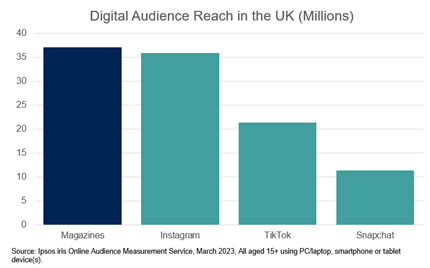
    The online magazine sector reaches 37.1m people in the UK every month; that’s more people than Instagram, TikTok, and Snapchat with respective audiences of 35.9m, 21.4m, and 11.4m.  

    Across more than 500 profiling points, Ipsos iris helps you to understand more about the audiences your brands reach, including everything from demographics to attitudes to online behaviour.

    Ipsos iris provides you with all the insight you need to inform your audience and product development strategy. Whether that’s through leveraging existing content, creating new content, or launching new products.

    2. Ipsos iris informs content planning and development to help you drive engagement and achieve standout in market

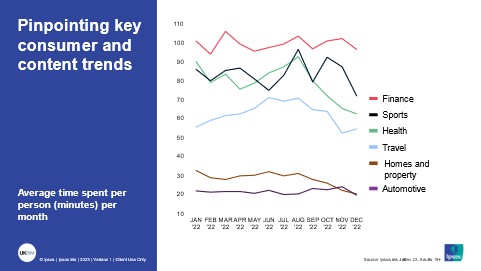
    Knowing where people spend their time online, and what content they visit, is essential to inform content planning and development. Ipsos iris allows you to pinpoint key consumer and content trends. 

    Simply plotting average time spent with key content verticals across the last 12 months provides actionable data to inform content planning and development. This is illustrated in the graph below, where we can see consumption peaks for sport in August with the return of the Premier League. In January everyone starts the year with good intentions, and consumption is high for health-based content, while seasonal travel trends see corresponding peaks around summer and the New Year as holidays are top of mind. 

    Understanding content consumption spikes at a monthly, weekly, daily, and daypart level across brand and sectors presents you with new opportunities for audience monetisation and growth. It can also inform wider strategic decisions around search, social, and commerce.

    3. Ipsos iris helps you to build value across all your digital platforms.

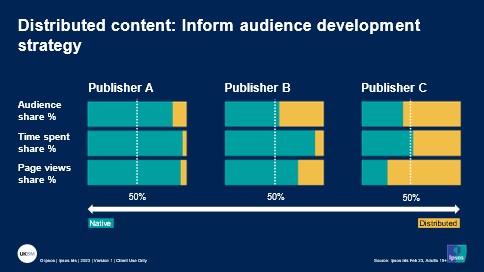
    Over the past few years, digital has presented us with multiple ways in which we can build out our audiences to reach more people with our content. Examples include aggregators such as Apple News, social platforms like YouTube, Facebook Instant Articles, new technologies such as Google AMP – and there are other formats which distribute and streamline video content too.

    Ipsos iris plays a central role in informing your content distribution strategy. We can do this by looking at your incremental audience and the impact your distribution strategies have on metrics such as page views and time spent. In the figure below, Publisher C has a larger audience consuming content via distributed content than on its own sites and apps (native). We see distributed content driving a greater share of page views, but lower share of time spent.

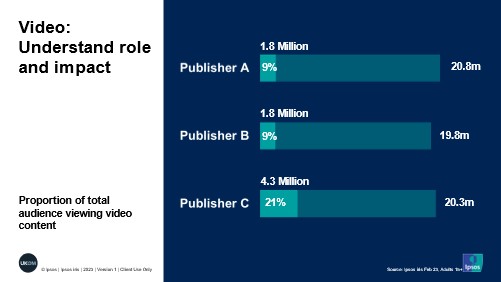
    We can also understand the role and impact of different formats of content – let’s take video to understand the role and impact at a market and brand level.

    Audiences vary across different publishers and platforms. Comparing total audience to video audience we can understand differences in demographics and identify unique audiences reached, amplifying the opportunity for content delivery.

    4. Ipsos iris contributes insight that unlocks advertising opportunities to help you to make more money.

    Proving why a magazine or newspaper deserves a share of campaign budgets, and identification of new potential advertising revenue streams is key to survival.  

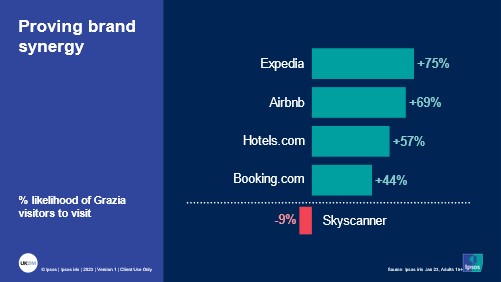
    Ipsos iris allows you to prove category and brand synergy across display, video, or marketing partnerships. Let’s take Grazia as an example; we can show that Grazia users are 29% more likely to visit travel sites, and 75% more likely to be visiting Expedia. That’s hard evidence for an advertiser to argue with.

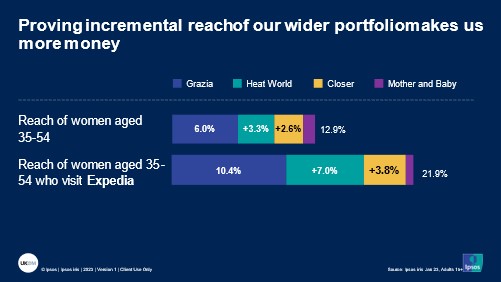
    Ipsos iris can also quantify the incremental reach our wider portfolio of brands bring – helping publishers achieve a bigger slice of the ad budget and profit. In the case of Grazia, and Bauer, the audience reach increases by 115% and 111% on the two core target markets.

    Ipsos iris’ unparalleled insight into digital audiences empowers your strategic decision making, helping you in every area of your business: from audience growth and monetisation, to content, and distribution strategy to advertising.

    For more information about how Ipsos iris can answer your key business questions please contact james.torr@ipsos.com or tracy.allnutt@ipsos.com