The Government has reiterated to the PPA its commitment to delivering the Digital Markets, Competition and Consumers Bill which will introduce new powers for the Competition and Markets Authority to regulate digital competition and establish better business conditions for specialist publishers.
Additionally, Ministers have acknowledged the PPA’s concerns relating to AI and will continue to engage with us on these issues in the coming months.
Our Public Affairs team will also be attending the Labour Party Conference next week and will report back on any relevant updates.
Category: Public Affairs
-

PPA attends Conservative Party Conference
-
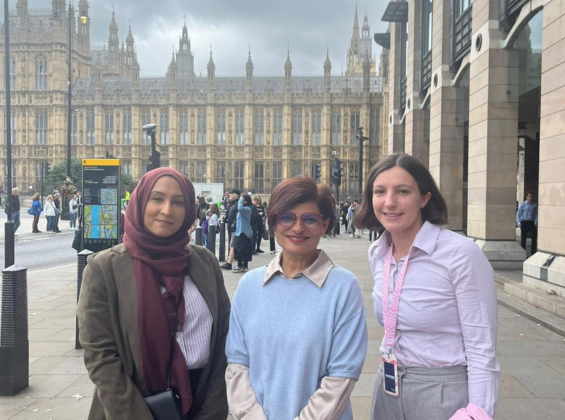
PPA meets new Shadow Secretary of State for Culture, Media and Sport
The discussion included AI and digital market regulation and how Labour might tackle these issues if they were to be elected into government in 2024.
The PPA will continue engaging with the Shadow Secretary of State for Culture, Media and Sport and will be arranging a members’ lunch with her soon. -
Online Safety Bill to become law
This legislation puts duties on platforms to take steps to remove illegal content and prevent children from accessing harmful and age-inappropriate content. However, it contains protections for “recognised news publishers” which prevent platforms from arbitrarily removing news content without providing notice and the right of appeal.
The PPA has been in conversation with government officials and the relevant regulatory bodies about whether our members will fall under the scope of these protections. The regulator is expected to launch consultation processes in the next few weeks on implementation, which we will be responding to.If you have any questions, please contact our Public Affairs and Policy Manager: Eilidh.wilson@ppa.co.uk
For more information about the Bill please click here. To read more about the protections for “recognised news publishers” click here.
-
New Shadow Secretaries of State for culture and tech announced
The Labour Party has appointed Thangam Debonnaire as the new Shadow Secretary of State for Culture, Media and Sport and also appointed Peter Kyle as the new Shadow Secretary of State for Science, Innovation and Technology.
This change aligns the Shadow Cabinet with the government departments (earlier this year, the Department for Digital, Culture, Media and Sport was split into the Department for Culture, Media and Sport and, separately, the Department for Science, Innovation and Technology).
In addition, Chris Bryant has been appointed as the cross-departmental Shadow Minister for Creative Industries and Digital.
The PPA will be contacting the offices of Debonnaire, Kyle, and Bryant to introduce ourselves as the trade body for the specialist publishing sector.
-

PPA signs Global AI Principles to protect publishers’ copyright
The Principles call for responsible development and deployment of AI systems and applications and state that “indiscriminate misappropriation of intellectual property is unethical, harmful, and an infringement of protected rights”.
The News/Media Alliance (USA) President and CEO, Danielle Coffey said: “These Principles demonstrate the widespread agreement of publishers around the world that their intellectual property, which is the product of significant investments they have made in providing quality journalistic and creative content, should be recognised and respected. AI systems are only as good as the content they use to train them, and therefore developers of generative AI technology must recognize and compensate publishers accordingly for the tremendous value their content contributes”.
Angela Mills Wade, Executive Director of the European Publishers Council added: “This paves the way for a powerful convergence of innovation and ethical development of AI. We invite regulators to establish legal frameworks that boost innovation and create new business opportunities while ensuring that AI develops in a way that is responsible and sustainable for the publishing and journalism sectors in full respect of their intellectual property rights”.
The Global Principles align with the PPA’s stance on AI and intellectual property, which we continue to amplify amongst stakeholders.
You can read more details of the Global Principles for AI here.
-
Parliamentary Committees issue statements on AI and copyright
The Science Committee published a report that states “some AI models and tools make use of other people’s content and policy must establish the rights of the originators of this content, and these rights must be enforced”.
Greg Clark, The Science, Innovation and Technology Committee Chair said: “[the Committee] will study the Government’s response to the interim report, and the AI white paper consultation, with interest, and will publish a final set of policy recommendations in due course”.
In addition, the DCMS Committee published a report which said that “the Government should consider how creatives can ensure transparency and, if necessary, resource and redress if they suspect that AI developers are wrongfully using their works in AI development”.
Speaking in relation to how the Government should support creative industries, the DCMS Committee Chair Caroline Dinenage said that: “[Ministers must] develop a copyright and regulatory regime that protects them as AI continues to disrupt traditional cultural production”.
The PPA is pleased to see these statements from MPs clearly expressing support for greater copyright protections for specialist publishers in the context of AI. The Government is required to formally respond to these reports in October. We will monitor these responses and update on any significant developments.
Separately, the PPA has submitted evidence to the Digital and Communications Committee in the House of Lords as part of an ongoing inquiry into large language models (LLMs). We have used this as an opportunity to reiterate our key messages about the need for the enforcement of transparency provisions for AI developers.
-

PPA calls on Prime Minster to enforce AI transparency
The letter calls attention to the fact that publishers’ content is being used to train AI tools without permission or any form of payment. Therefore, without transparency enforcement provisions, publishers have no means of asserting their copyright and addressing infringements.
In an interview with Press Gazette, PPA Chief Executive Sajeeda Merali said: “if there’s no government intervention, then this is going to have quite a serious adverse impact on the sustainability of the industry […] content creators will have no means of monetising their content”.
The PPA will continue to raise awareness of these issues with political stakeholders and lobby for better regulatory conditions for the specialist publishing sector.
Sajeeda Merali’s full interview with Press Gazette can be read here.
More details on the government’s AI White Paper can be found here.
-

AI Minister confirms the Government’s position on AI and copyright in House of Lords Debate
In a debate in the House of Lords this week, Minister for Artificial Intelligence (AI) and Intellectual Property (IP), Viscount Camrose, confirmed the Government’s position on copying works in order to extract data in relation to copyright law.
He said that “under existing law, copying works in order to extract data from them will infringe copyright, unless copying is permitted under a licence or exception”. However, he also added that “the legal question of exactly what is permitted under existing copyright exceptions is the subject of ongoing litigation”.
Several peers, including Chair of the Communications and Digital Committee, Baroness Stowell, reiterated publishers’ concerns about intellectual property during the debate. Viscount Colville of Culross also added that he is worried about the impact of AI on journalism, as “AI-generating companies can scrape for free the information from news websites, which are already facing increasing costs to create”.
Lord Ravensdale, a non-partisan peer who sponsored the debate, expressed support for the Government’s White Paper but stressed that “speed is the problem here” and that the Government needs “to start thinking immediately about the initial regulatory framework”. He recommended that the Government consider “as a minimum putting their five principles in the White Paper on a statutory footing in the near term to provide regulators with enhanced powers to address the risks of AI” and also suggested that an “AI Bill” could be brought forward to legislate for a new AI research organisation and provide regulators with the powers and resources to address the challenges of AI”.
Next steps: The PPA will continue to lobby the Government to bring forward transparency provisions so that copyright infringements of companies who own AI systems can be addressed. We will also be submitting written evidence to the Communications and Digital Committee’s call for evidence on large language models (LLMs). To hear more about our work in this area, please contact the PPA’s Policy & Public Affairs Manager Eilidh.wilson@ppa.co.uk.
-
PPA to submit a response to Digital and Communications Committee inquiry into Large Language Models
The Committee will collect evidence from experts and then conclude its inquiry with a series of recommendations to the Government which the Government will then later respond to.
LLMs are machine learning models, a type of Artificial Intelligence algorithm, designed to learn the statistical properties of text content to generate new text that mimics the style of the original input text. ChatGPT is an example of a LLM.
Next steps: The PPA will be submitting a response to the Committee’s call for evidence to support the inquiry.
If you wish to hear more about this or feed into the submission, please contact the PPA’s Policy & Public Affairs Manager Eilidh.wilson@ppa.co.uk.
-

Parliamentary debate on AI: MPs reiterate the PPA’s concerns about copyright and transparency
Conservative backbench MP Matt Warman and Shadow Minister for Tech, Gambling, and the Digital Economy, Alex Davies-Jones asserted that transparency requirements for AI systems such as ChaGPT are key. This is something that the PPA briefed MPs on as a key priority for the special interest and magazine media industry as transparency requirements are key to understanding how publishers’ data is being scraped and used, and where the industry must seek redress or compensation for market failures.
Science and Technology Committee Chair Greg Clark and SNP spokesperson for Digital, Culture, Media and Sport John Nicolson both highlighted the PPA’s concerns that the Government needs to address the copyright issues stemming from recent developments with AI. This resonates greatly with the messaging the PPA put out to these parliamentarians about how our existing copyright laws must not be eroded in the context of AI.
Additionally, Clark also stressed that “regulators, in particular our competition regulators, will need to pay attention to [the danger of market power being concentrated by] a very small number of companies, [at the expense of contestability and competition]”. This aligns with the calls the PPA has been making to MPs to ensure that the competition regulator is equipped to address market power obtained by companies who own AI systems.
This comes after the PPA submitted a response to the Government’s White Paper on AI, which the Government has said it will submit a formal response to within the next few months.
Next steps: In the meantime, the PPA will continue to lobby MPs, Government, and regulatory officials to raise awareness about the urgent need for action to tackle the lack of Intellectual Property protection in regard to AI.