- Contract allows publishers to quickly and easily charge AI companies for content harvesting
- PPA joins industry voices to support initiative to help build viable AI content economy
- 31 UK websites have already deployed new usage terms pre-launch
Digital competition advocacy group the Movement for an Open Web (MOW) has launched a new website contract that publishers are using to assert their content ownership rights over AI harvesters, giving them the ability to charge AI companies for using their content.
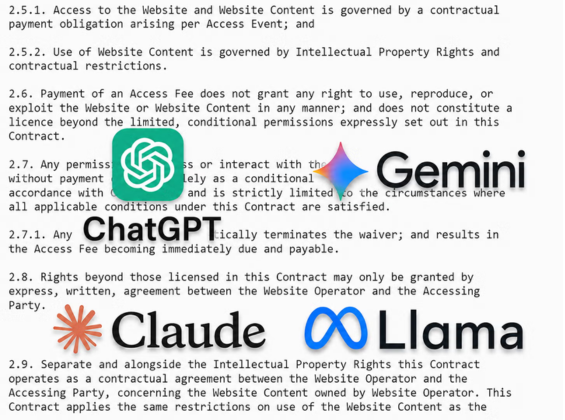
The search only contract (SOC) is a set of website usage terms that can be freely used by any site owner to set the terms of access by AI harvesting bots. The contract only permits indexing for search and human, non-commercial use. All other access requests a deal or attracts a fee.
The SOC already has widespread support and adoption from publishers and the wider industry, with more than 31 websites having already deployed the contract ahead of its launch, including Trusted Reviews, Recombu, Road.cc, CaughtOffside, FootballItalia and many more. Industry bodies including the PPA, Thinkbox, Impress, AOP, and The Football Writers’ Association are also publicly supporting the SOC’s goals and approach.
The SOC brings a new approach to the question of unwanted AI harvesting and payment for content. Rather than relying on IP or copyright laws, which are complex and difficult to litigate, the contract simply asks for a deal or sets a charge for non-permitted site access, giving site owners the option to invoice for payment easily. Non-payment can lead to enforcement via the County Court or other forums. This simple payment approach prevents AI companies from burying compensation in years of appeals and legal arguments.
AI harvesting is a massive issue for the publishing industry. AI companies are stealing content from publishers and then using that content to take the traffic on which those publishers survive, undermining the very existence of the online publishing industry. Google in particular has destroyed the quid pro quo that has underpinned its relationship with publishers by stealing traffic via AI Overviews with some publishers seeing Google referral traffic fall by over 60%. Additionally, up to 49% of website traffic is now bots (according to Fastly), with 99% of that traffic being unwanted. Publishers are paying to have their content stolen.
Tim Cowen, co-founder of the Movement for an Open Web, said: “This is a straightforward contract for payment for content online. By avoiding copyright and IP law, and using basic contract law instead, a tried and tested mechanism is available to publishers wishing to get paid. Using the SOC, if content is taken without permission or payment, website owners can simply invoice AI businesses for the content that they have taken and – if they don’t pay – pursue them through the County Courts for quick and cost-effective resolution.
“The SOC for the first time puts a price on content usage by AI and – in doing that – creates a viable marketplace for publishers’ content assets. The AI companies can’t ignore this, with a critical mass of support from publishers they are going to be forced to the negotiating table or else will face an ever-growing volume of court summons.
“The CMA’s recent ruling on Google’s AI harvesting further strengthens the position of the Search Only Contract. It demonstrates that Google’s theft of publisher content without permission is unacceptable and it forbids Google from retaliating against those who choose not to give their content away for free. It places a requirement on Google not to retaliate.”
Chris Dicker, CEO of Candr Media, publisher of TrustedReviews.com, said: For too long the AI companies have had a free hand to steal our content, traffic and IP for their own gain. With the Search Only Contract we finally have a legal means to assert our ownership and take back control. The AI companies agree to the terms the moment they access our site, and if they breach them by using our content in their services, we issue a demand for payment. No negotiation, no grey areas. You took it, you pay for it.”
Lexie Kirkconnell-Kawana, CEO of UK press regulator Impress, said: “At Impress, it is our job as a press regulator to safeguard the future health of ethical, responsible journalism, which is why we wholeheartedly support Movement for an Open Web’s Search Only Contract,
“Much of the ‘intelligence’ in AI is produced by human efforts of journalists and publishers around the world. It is entirely fair that these creative professionals should have the right to say how or whether multi-billion-dollar tech firms can use their work. Silicon Valley should be accountable for the extraction inflicted on this industry through fair and enforceable value exchange. The launch of this contract is an important step in that reckoning.”
Sajeeda Merali, CEO, the PPA, said: “Publishers invest significant time, expertise and resources into creating original, trusted content. As AI continues to transform how information is discovered and used, it is essential that publishers have meaningful control over their content and a fair opportunity to secure value from it.
“The Search Only Contract is an interesting approach that seeks to give publishers additional choices over the terms on which their content can be used. While there will be different approaches to licensing and monetisation, what matters is that PPA members have options and bargaining power in the AI ecosystem.”
Lindsey Clay, CEO Thinkbox, said: “Every professional content publisher should applaud this initiative. It’s urgently needed to protect the future of quality editorial IP. This has been theft in plain sight for too long. I hope this gets the backing it deserves to safeguard the vital journalism and trusted content that have never been more needed.”
Will Muirhead from the Football Writers’ Association, said: “AI systems are now capable of producing detailed answers to complex questions about matches, players and transfers within seconds. For readers, that convenience is obvious. For journalists, however, it raises a difficult question: if AI platforms summarise, synthesise and repackage our work without readers ever visiting the original source, how does the reporting that feeds those systems continue to exist? The FWA believes MOW’s initiative provides an answer to that question and we are recommending its implementation to our members: journalists must be paid for use of their work by AI.”
Tony Farrelly, Head of Content at F-At Digital publisher of cycling titles road.cc, off.road.cc and ebiketips.co.uk said: “None of Claude, Gemini, ChatGPT, or AI Mode can ride a bike nor tell you from first hand experience how it handles in traffic or on a mountain road, but that hasn’t stopped them taking the words of those that can, without permission or payment, putting their livelihoods at risk in the process.
“It’s clear that if independent and specialist publishers want to get a fair deal from Google and the AI companies then we’re going to have to band together and do it ourselves as neither Government nor regulators have shown the will to hold the tech companies meaningfully to account while they steal our content, reduce our revenues and, most importantly, threaten the jobs of the thousands of talented people that work across the independent media sector. That’s why we’re happy to be a part of the Movement for an Open Web’s Search Only Contract initiative.”
Richard Reeves, Managing Director, AOP, added: “AOP continues to encourage all publishers to make use of the initiatives at their disposal to support the drive toward a fair value exchange. This is the only way to ensure the marketplace evolves in a direction that sees publishers of original journalism appropriately compensated for the use of their hard-earned, cost inducing intellectual property.
“The Search Only Contract is one of these initiatives. It is simple to deploy, machine readable, and sitting within the Robots.txt protocol, employing a frictionless common legal language that creates consistency, while complimenting existing T&C’s publishers may choose to utilise. Easy-to-employ tools such as this will empower our industry to adapt to the changing digital world, and shifting consumer behaviours, while also help publishers thrive.”
How does it work?
The SOC is free to use and easy to implement. It has been created by the Movement for an Open Web, an advocacy organisation that has been fighting to protect the open web since 2020. MOW is providing it free of charge to help support the creation of a fairer content ecosystem in the face of the AI giants’ ongoing theft of content and IP. The contract is hosted online and websites wishing to use it can simply link to it from their Robots.txt file and/or their website terms of use and website footer. The SOC is compatible with all existing website usage terms as well as any content licensing agreements and copyright law.
The SOC is compatible with the recently announced CMA Conduct Requirements on Google. Whilst the Conduct Requirements will give publishers the ability to opt in or out of their content being used in Google’s AI services, it says nothing about compensation for that usage. With the SOC, publishers can either choose to opt out of Google’s AI services and control other AI harvesting through the contract or can opt in to Google’s usage but set the terms of that access according to the SOC’s clauses. The CMA’s Conduct Requirements also sets out that Google cannot retaliate against publishers for using AI controls by harming their prominence in search, ensuring that implementation of the SOC is risk free for publishers.
For more information visit the SOC here.
You can find a guide to its implementation here.