
Action 3
Resources
If you need more information, fill out the form below and we will be in touch
Setting targets
What is Action 3 about?
Action 3 is about setting GHG emissions reduction targets.
Action 1 and Action 2 cover the measurement of Scopes 1 and 2 emissions (i.e. your company’s own emissions) and Scope 3 emissions (i.e. emissions generated throughout your value chain). Measuring Scopes 1, 2 and 3 allow organisations to prepare their GHG inventories.
Once this is done it is important to set GHG emissions reduction targets.
By signing to the PPA Action Net Zero Pathway, organisations commit to set GHG emission reduction targets that are consistent with our industry-wide ambition to achieve net zero as early as possible, and by 2050 at the latest.
PPA encourages its signatories to set interim targets as well as defining a deadline to achieving net zero.
Why is it important?
Setting GHG reduction targets provides a clear direction as to what your company is striving to accomplish.
It allows organisations:
- to plan for resources and investments required to deliver towards these targets. Without targets, it would be difficult to get the approval from senior management for these resources.
- to be proactive in reducing GHG emissions and be prepared for potential future GHG regulations.
- to position themselves as responsible businesses and leaders in mitigating climate change. Setting interim targets is particularly important to demonstrate leadership.
How to tackle it?
- The PPA Action Net Zero Pathway aims to, collectively with its signatories, achieve net zero by 2050 at the latest. Signatories need to set a deadline for reaching net zero across Scopes 1, 2 and 3, which should be before or by 2050.
- It is strongly advised to also set interim reduction targets to be achieved by e.g. 2030.
- It is expected that most companies will have to reduce their (Scopes 1, 2 and 3) emissions by at least 90% by 2050. The remaining emissions therefore need to be neutralised (through removal of carbon from the atmosphere and permanent storage) to achieve net-zero.
- Guidance on how to set targets can be found in the next section.
Ultimately, publishers should:
- set ambitious targets in line with the science (both long-term and near-term) to reduce their GHG emissions as early as possible.
- develop a plan for achieving their targets
- encourage their value chain and beyond, to reduce their GHG emissions.
- share their learnings and achievements
- invest in carbon removal and storage solutions for residual emissions.
Resources
- Action 3: Setting targets
- Tools:
Other resources might be developed as required
Action 3: How to set targets
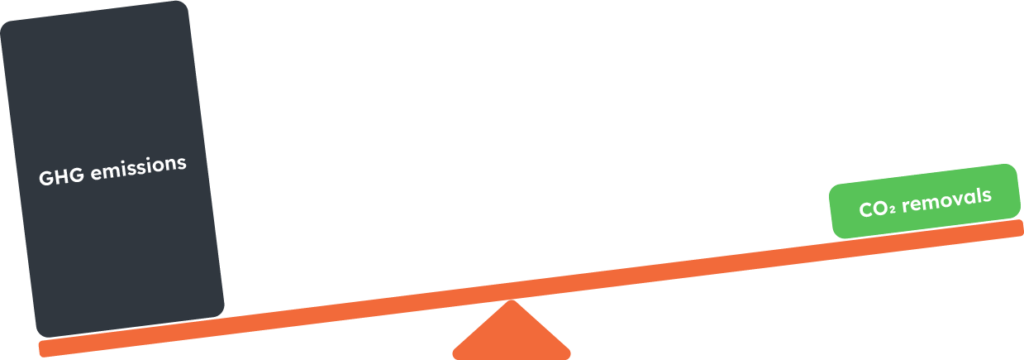
Currently
(Large amount of GHG emissions and little CO2 removals)

Reaching Net Zero requires reduction of GHG emissions to as close as possible to zero + CO2 removals to compensate remaining GHG emissions
Key steps to reaching Net Zero
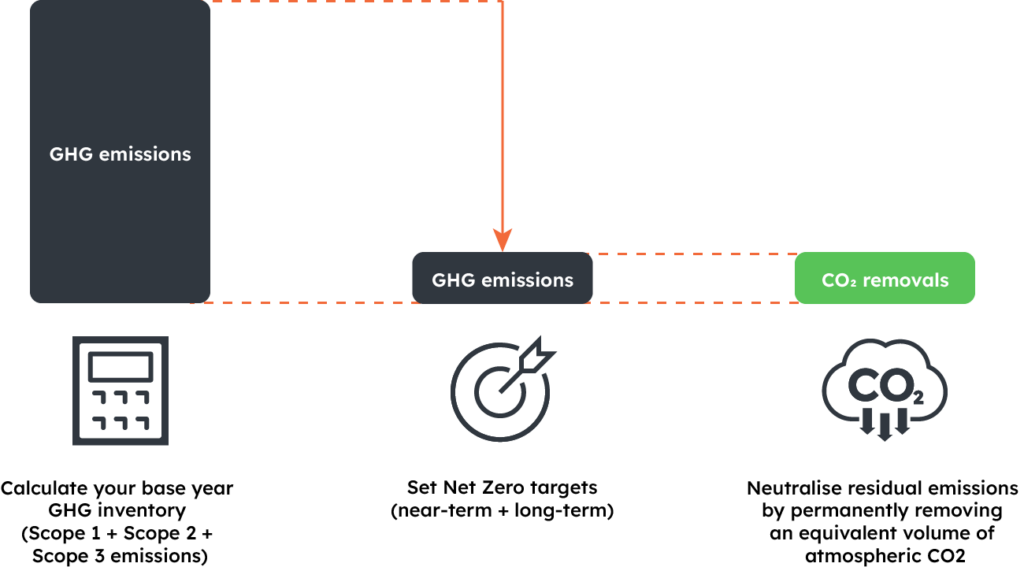
How to set targets

Define your base year
In order to set net zero targets, an organisation must choose a base year against which its emissions (i.e. GHG inventory) will be tracked overtime.
To choose the base year:
- It is recommended to select the earliest year with verifiable emissions data for scopes 1, 2 and 3. Some reputable initiatives, such as the Science-based Targets initiative (SBTi), however require organisations to choose a base year that is no earlier than 2015.
- The base year should reflect the company profile (i.e. the chosen year must be representative of the company’s typical emissions footprint). If, for example, Covid has impacted the GHG emissions, these years should be avoided as a base year.
In addition to choosing your base year, organisations need to develop a base year policy, which aims is to define a ‘significance threshold’ i.e. a threshold which would trigger the recalculation of the base year. Organisations have to use this base year policy, including the significance threshold, consistently.
For consistency, we recommend signatories of the PPA Action Net Zero Pathway to use a significance threshold of 5%.
Further guidance regarding base year recalculation is in development.

Set Net Zero targets
SBTi provides a framework to set Net-Zero targets that publishers might find helpful to consult.
The guidance below was developed using the SBTi approach as reference and summarises the key points and types of targets that are relevant to publishers.
Net zero targets clearly define coverage, ambition, timeframe and type of targets. Examples are given in the table below.
- Setting long-term Net Zero targets:
The PPA Action Net Zero Pathway aims to reach Net Zero collectively by 2050 at the latest. Signatories of the pathway should therefore set long-term Net Zero targets to be met by no later than 2050.
PPA recommends setting a long-term absolute reduction target for Scopes 1 and 2 combined and another absolute reduction target for Scope 3.
It is anticipated that the Scope 3 reduction target will be set to be met by 2050 (although an earlier deadline is encouraged when possible).
However, it is expected that the Scopes 1 and 2 reduction target is reached well before 2050.
Also, in addition to the long-term Net Zero targets, PPA strongly recommends publishers to set near-term targets.
- Setting near-term targets:
For Scopes 1 and 2, a near-term absolute reduction target should be set with a deadline in 5 to 10 years.
To define the target ambition (i.e. how much absolute reduction needs to be achieved), publishers may want to use the target setting tool developed by SBTi.
Scope 3 reduction targets are difficult to meet in the near-term. For this reason, the PPA recommends setting a supplier engagement target to be met within five years of setting the target. This type of target consists of engaging a number of suppliers to encourage them to set Scopes 1, 2 and 3 Net Zero targets.
The PPA also recommends setting a target to switch to renewable energy within five years of signing-up to the PPA Action Net Zero Pathway.
Examples of long-term and near-term targets are shown in the table below.
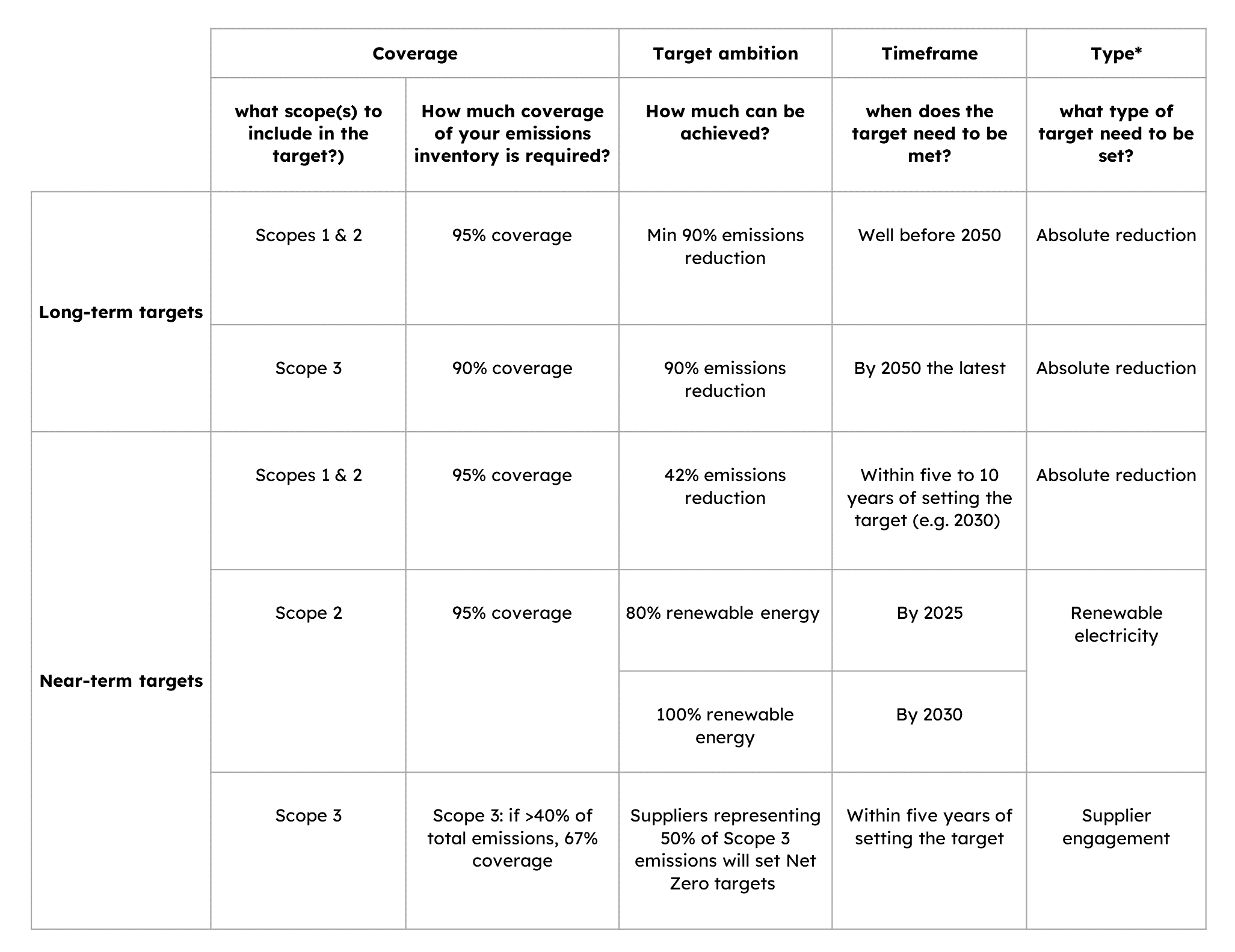
* Other types of targets are possible. A description of those can be found in the SBTi Corporate Manual.
The PPA recommends setting long-term and near-term targets within 24 months of signing up to the Action Net-Zero Pathway.
- Streamlined process for SMEs:
SBTi developed a streamlined pathway for small and medium-sizes enterprises (SMEs), defined as a non-subsidiary, independent company which employs fewer than 500 employees. SMEs can set targets by selecting predefined target options. They are also not required to set near-term Scope 3 targets. However, SMEs are required to measure and reduce Scope 3 emissions and to set a long-term Scope 3 Net Zero target.
Target options for SMEs:
- Near-term science-based targets are absolute scope 1 and 2 GHG emissions reduction or maintenance targets that should be achieved by 2030, from a predefined base year.
- Net-zero targets* include:
-
- Long-term science-based targets which are absolute scope 1, 2 and 3 GHG emissions reduction targets that should be achieved by 2050 at the latest, from a predefined base year.
-
- A commitment to neutralize any unabated emissions when the long-term science-based target is achieved.
For further information about the SBTi SMEs streamlined process, see the SBTi Target Validation Application for Small and Medium-Sized Enterprises (SMEs)
Neutralise CO2 emissions
To achieve Net Zero, any residual emissions once reduction targets have been met, must be removed and stored permanently from the atmosphere. Information on carbon removals will be covered as part of another guidance to be developed at a later stage.