
Action 1
Resources
If you need more information, fill out the form below and we will be in touch
Addressing emissions from our own operations and electricity consumption.
What is Action 1 about?
Action 1 is about cutting publishers direct emissions.
This consists of identifying the GHG emitted as a result of your organisation’s own and direct activities and operations (Scopes 1 and 2 GHG emissions). Once your own organisation’s emissions are identified, they need to be measured and reported using a standardised and scientifically sound methodology.
For publishers, Scopes 1 &2 emissions are likely to be mainly related to heating and electricity consumption in the office(s) and fuel consumed in company’s vehicles.
Why is it important?
Addressing Scopes 1 and 2 emissions is the first step into a journey to net zero.
- Scopes 1 and 2 emissions are the ones that organisations have the most control over and are therefore the easiest to address.
- Although for publishers these emissions represent a small proportion of the rest of their value chains, every tonne of GHG emissions prevented helps to mitigate the impacts of climate change.
- Customers (e.g. advertisers) will also expect publishers to monitor, report and reduce their emissions for them to reduce their own Scope 3 emissions.
How to tackle it?
- The first step is to identify and list all your operations and activities; then understand what activities and associated emissions need to be reported under Scope 1 and Scope 2.
- The publishing industry can reduce Scope 1 and 2 emissions by sourcing cleaner energy and through energy efficiency measures e.g. installing more efficient equipment, moving to renewable energy and moving to electric company vehicles.
- Further guidance about what is covered in Scope 1 and in Scope 2 is provided in the next section “Quantifying Scope 1 and Scope 2”
Resources
- Action 1: Quantifying Scope 1 and Scope 2
- Scope 1 and Scope 2 Tool for publishers (currently in development)
Other resources might be developed as required
Action 1: Defining Scope 1 and Scope 2 emissions
Organisational boundaries:
Before quantifying Scope 1 and Scope 2 emissions, companies need to define their organisational boundaries, which consists of defining which company operations to include in the GHG Inventory.
Organisations need to determine whether to report GHG emissions from any subsidiaries or joint ventures for example.
There are three options to define organisational boundaries: equity share, financial control or operational control.
For consistency, PPA recommends using the operational control (i.e. authority to introduce and implement operating policies) method.
Under the operational method, if a company A has operational control over a company B, 100% of the emissions from company B should be accounted to company A.
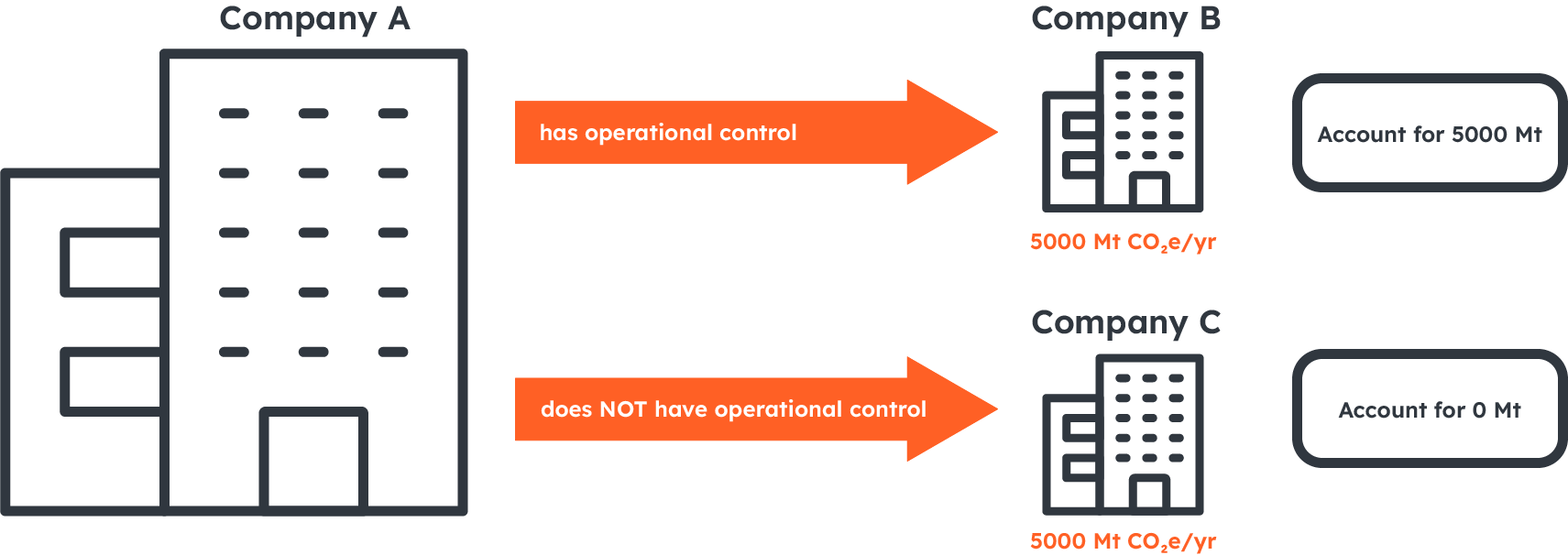
For further information about the operational control method as well as for the other two methods (equity share and financial control), please refer to the Greenhouse Gas Protocol – A Corporate Accounting and Reporting Standard (Chapter 3 – Setting Organisational Boundaries)
Note: The PPA Action Net Zero Programme has a UK focus. Therefore, although signatories are encouraged to calculate their emissions for all their operations, inside and outside the UK, they only have to report to the PPA Action Net Zero Pathway their emissions for their UK based offices. This means signatories will report Scope 1 and 2 emissions occurring in the UK. Scope 3 emissions however can be generated in or outside the UK (e.g. the office is based in the UK while the paper used to print the magazines is made in Germany).
Operational boundaries:
Once the organisational boundaries are defined, the reporting company needs to define its operational boundaries. This consists of determining which emissions sources to include and how to categorise these emissions (i.e. under which Scope).
Scope 1 emissions are direct GHG emissions from sources a company owns or controls.
Scope 2 emissions are indirect GHG emissions from the generation of purchased electricity, steam, heating and cooling.
Potential Scope 1 emissions for publishers include:
- Emissions from fuels used for hot water and heating (e.g. natural gas used in boilers) in owned or leased buildings
- Emissions from fuels used in non-electric company owned or leased vehicles
Note: Emissions from fuels used in hire-cars and/or in company cars that are provided to individual employees as a benefit, are excluded from Scope 1
- Refrigerant gases leaking from the use of air conditioning units. For publishers this is expected to be negligeable and, in this case, does not have to be reported
Potential Scope 2 emissions for publishers include:
- Electricity consumed at the offices (whether owned or leased), including electricity for charging electric vehicles which are charged at the offices
- Electricity for charging electric vehicles, whether owned or leased by the company, which are charged at public charging points. In this case, the data can be taken from charging bills
Note: electricity for charging electric hire cars or company cars provided as an employee benefit is excluded from Scope 2.
Note: When the reporting company uses (a) shared office(s) and separate consumption data is not available, the emissions to be reported for heat and hot water (Scope 1) and electricity (Scope 2) should be based on a percentage of the surface used by this reporting company.
Scope 2 accounting methods
There are two methods to determine the emissions associated with electricity consumption:
- The location-based method reflects the average emissions intensity of grids on which energy consumption occurs
- The market-based method reflects emissions from electricity that companies have purposefully chosen
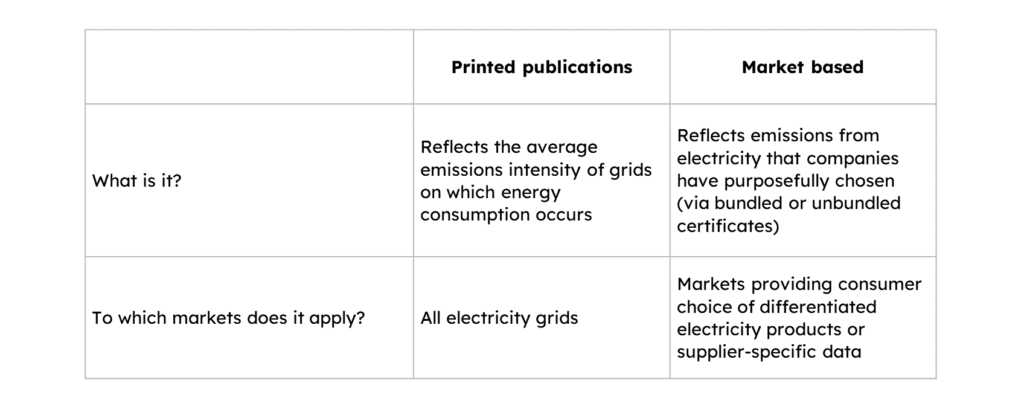
When should the different method be used?
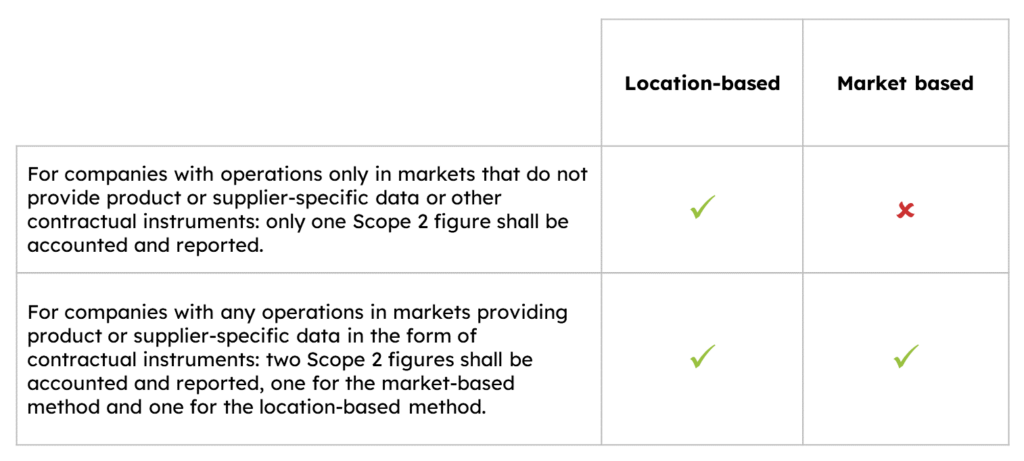
As we are reporting on emissions from offices located in the UK, results should be reported using both the location-based and market-based approach.
Summary of potential Scope 1 and Scope 2 emissions for publishers
Scope 1

Emissions from fuels (e.g. natural gas, oil) used for hot water and heating (in buildings owned, controlled or leased by the publisher)

Emissions from fuels used in non-electric vehicles (for vehicles owned, controlled or leased by the publisher)
Note: emissions from hire cars and company cars as an employee benefit are excluded.

Refrigerant gases leaking from the use of air conditioning (note: this is expected to be negligeable and therefore does not have to be reported)
Scope 2

Emissions from the purchase of electricity consumed at the office(s)
Note: this includes electricity used to charge electric vehicles at the office(s)

Emissions from electricity used for charging electric vehicles, owned, controlled or leased by the company, at public charging points.
Note: emissions from electricity used for charging hire cars and company cars as an employee benefit are excluded.
Action 1: Quantifying Scope 1 and Scope 2 emissions – Data needed
Once the sources of emissions are identified (see previous section ‘Action 1: Defining Scope 1 and Scope 2 emissions’, the reporting organisation should:
- collect data and choose emission factors
- calculate Scope 1 and Scope 2 emissions
There are several ways to calculate GHG emissions. The most common way, which is also the recommended one for publishers, is to use emission factors.
Scope 1
Emissions from fuels (e.g. natural gas, oil) used for hot water and heating (in buildings owned, controlled or leased by the publisher)
Data needed:
- Type of fuel(s) used for hot water and heating
- Purchased quantity of fuels
- CO2, CH4 and N2O emission factors for the fuels purchased*
- Global Warming Potential (GWP) for CH4 and N2O*
Emissions from fuels used in non-electric vehicles (for vehicles owned, controlled or leased by the publisher)
Data needed:
- Purchased quantity of fuels for non-electric vehicles
- Emission factor(s) for the fuel(s) purchased*
Refrigerant gases leaking from the use of air conditioning
NOT RELEVANT
(This is expected to be negligeable and therefore does not have to be reported)
Scope 2
Emissions from the purchase of electricity consumed at the office(s)
- Metered electricity consumption
- Percentage of office surface used (only relevant for shared offices)
- supplier-specific or local grid emission factors**
Emissions from electricity used for charging electric vehicles, owned, controlled or leased by the company, at public charging points
- Electricity consumption (taken from charging bills)
- Local grid emission factors
* Emission factors and GWP are provided in the Scope 1 & Scope 2 Scoping document and have been added to the Scope 1 & Scope 2 Tool.
** Local grid emission factors are provided in the Scope 1 & Scope 2 Scoping document and have been added to the Scope 1 & Scope 2 Tool.
Once internal data have been collected, publishers can use Scope 1 & Scope 2 Tool to calculate their Scopes 1 & 2 GHG emissions.
Action 1: Managing Scope 1 and Scope 2 emissions – Opportunities for reduction

Best contribution

Moderate contribution

Limited contribution
Office(s)
Fossil fuel or biofuel used for heating and hot water (Scope 1)
Reduce energy consumption e.g. by using a more efficient boiler and/or by insulating the building/office
Reduce Scope 1
Switch to electric heating using conventional sources of electricity
Reduce Scope 1 but increases Scope 2
Switch to electric heating using electricity from renewable sources
Reduce Scope 1 ad Scope 2 to zero
Switch to renewable energy by e.g. installing solar panels
Reduce Scope 1 to potentially zero, without increasing Scope 2
In the case of a leased office, encourage the landlord to install energy efficient equipment or switch to renewable energy
Reduce Scope 1
Electricity consumption (Scope 2)
Reduce electricity consumption e.g. by switching off equipment when not in use, using energy efficient equipment and LED lighting
Reduce Scope 2
Purchase electricity from renewable sources. For example, organisations can purchase Renewable Energy Certificates (RECs) or Power Purchase Agreement (PPA)
Reduce Scope 2
Install on-site solar panels
Reduce Scope 2 to zero without increasing Scope 1
In the case of a leased office, encourage the landlord to install energy efficient equipment or switch to renewable energy
Vehicles
Fuel used in non-electric vehicles (Scope 1)
Reduce consumption of fuel e.g. by reviewing necessity of travel, encouraging colleagues to travel together, considering greener alternative ways to travel
Reduce Scope 1
Switch to electric cars
Reduce Scope 1
Electricity used for charging electric vehicles (Scope 2)
Reduce electricity consumption e.g. by reviewing necessity of travel, encouraging colleagues to travel together
Reduce Scope 2