British Vogue has launched Vogue Values, a new editorial and social initiative designed to explore the power of fashion as a force for cultural progress, transformation and inclusion.
This year-long project, developed in partnership with eBay and Nike, centres on four key pillars: sustainability, women’s health, equitable access to creativity, and representation across the fashion industry.
Vogue Values marks the latest phase in British Vogue’s efforts to spotlight diverse voices and create real-world impact through the lens of fashion. The initiative launches with its inaugural campaign: ‘Fashion is for Everyone’, a statement of intent aimed at breaking down the barriers that have historically excluded individuals from fully participating in fashion and self-expression.
The campaign is in collaboration with leading charities Smart Works, which provides clothing and coaching to women for job interviews and workplace success, and Give Your Best, a platform enabling direct clothing donations to women who are refugees and seeking asylum. Both partnerships highlight how fashion can serve as a powerful tool for transformation and empowerment.
Fashion is for Everyone will feature a range of ambassadors, with model Jourdan Dunn announced today as the first. She contributes a personal essay to the July issue of British Vogue, recalling the impact of discrimination, limited representation, and self-doubt, which she experienced in the early stages of her career, often being told there was no space for her in the industry – including at one point being told “they’re not having Black girls this season.” Yet through perseverance, mentorship, and finding strength in her vulnerability, Dunn emerged as a powerful symbol of resilience.
Chioma Nnadi, Head of Editorial Content at British Vogue, said:‘Vogue Values is about redefining who gets to be seen, heard and celebrated in fashion. The goal is not just to talk about change, but to help drive it—in wardrobes, workplaces, and communities. This is an important moment for British Vogue to recommit to creativity with conscience, and to ensure the people shaping the future of fashion reflect the world as it truly is.’
Kirsty Keoghan, Senior Director of European Fashion at eBay added: ‘Vogue Values reflects eBay’s commitment to making fashion more circular, conscious, and culturally relevant. Over the past few years, we’ve worked to shift perceptions — re-framing pre-loved not just as accessible, but as aspirational and style-driven. This initiative mirrors a broader shift in fashion, where sustainability, inclusivity, and creativity are becoming essential. As a leader in pre-loved fashion, eBay is proud to stand alongside Vogue in driving these conversations — and in using both industry influence and editorial storytelling to create meaningful change.’
Over the coming months, Vogue Values will feature a series of editorial features, social-first video, events and social storytelling moments, spotlighting a roster of talent across fashion, entertainment, and culture, always underpinned by the four key pillars of this project. Each will bring their own unique perspective on what inclusivity, empowerment and self-expression mean today, and how fashion can be a vehicle for change.
Cushing brings over 10 years of international product management and strategy experience, most recently as Product Lead at Amazon for European Consumables Customer Experience, where she was responsible for global new feature development and the website shopping experience for worldwide FMCG.
Cushing commented: “Immediate is a company known for its brands, innovation, and mission to bring joy. Immediate brands truly understand the power of great content. I’m excited to lead Product with a relentless focus on the customer experience, deepening the connection between our customers and the brands they love.”
Immediate’s digital growth is accelerating, with more than 750,000 premium app subscribers, digital subscriptions overtook print for the first time in 2024. Immediate’s website portfolio attracts more than 21m UK visitors a month and its podcast portfolio received almost 33m downloads in 2024.
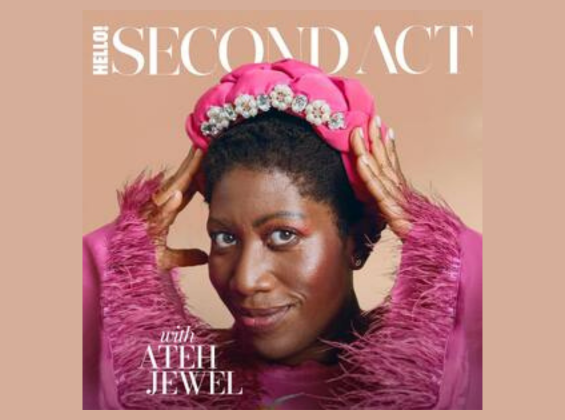
Actor Tamzin Outhwaite is Jewel’s first guest, discussing her return to dating in her 50s, the pressures of being in the ‘sandwich generation’, and the wellness secrets that have helped her through perimenopause. The podcast is sponsored by Absolute Collagen.
Building on the success of HELLO!’s existing podcast business, with nearly seven million downloads to date, the Second Act podcast brings another dimension to the portfolio, with actionable and relatable content specifically designed for all aspects of midlife, including careers, caring, relationships ones, health, and wellness.
HELLO!’s Chief Content Officer, Sophie Vokes-Dudgeon, comments, ‘When all the noise around midlife began to sound negative and pessimistic, HELLO! launched Second Act to reframe that narrative. Understanding the significant physical, mental and emotional changes for women in midlife, but seeing this stage as the start of an exciting second chance – one where we really know who we are and what we want. Second Act has found an optimistic audience, eager to connect with us, our experts and each other to make sure their next chapter is as bold and fulfilling as it can be.’
Recent content signings include Fast Company, Boston Globe Media, New York Magazine, Frommer’s, Reader’s Digest, The Nation, Newsday, The New Republic, The Philadelphia Inquirer, and Future, owner of specialist media sites such as Tom’s Guide, Who What Wear, and Homes & Gardens.
Bill Gross, CEO of ProRata said: “Publishers everywhere are rallying behind ProRata because we prove that generative AI can both honour creators and deliver an outstanding user experience. Gist.ai answers every query using 100 percent licensed content so consumers get authoritative, accurate answers and publishers share in the value their important journalism creates – all made possible by our state-of-the-art attribution technologies.”
ProRata’s patent pending attribution systems analyse AI output, measure the value of contributing content from contributing sources, and calculate proportional compensation. The company uses a proprietary algorithmic approach to score and determine attribution, enabling copyright holders to share in the upside of generative AI by being credited and compensated for their material on a per-use basis – turning AI from a threat into a new revenue stream.
Pauline Frommer, co-president of Frommer Media LLC added “AI driven search does not have to be based on theft; publishers can, and should, be compensated for the use of their copyrighted material. No machine can sleep in a hotel bed to review a property, eat at a restaurant, or explore a new museum, amusement park, or monument. These tasks, and the writing that comes from them, will remain the work of human journalists, and compensation for that work is necessary for it to continue.”
Andrew Min, VP, Global Partnerships & Licensing at Future said “We’re committed to growing the reach of our trusted brands by connecting global audiences with our high-quality, expert content. Our collaboration with Gist.ai allows us to distribute our specialist content across new and innovative platforms, helping more people find accurate information from sources they can trust.”
Building on its content momentum, ProRata recently unveiled ProRata Ads, an advertising platform that maximises the value of high-quality content by using large-language-model agents to place hyper-relevant ads inside AI answers and across digital content in real time. Early pilots on partner sites demonstrate sharp lifts in click-through rates and user engagement.
The following guidelines for publishers are in relation to the sale of printed magazines and books in the EU & Northern Ireland, produced in association Lewis Silkin LLP and Marketforce.
In light of the updated EU General Product Safety Regulation (GPSR), which came into effect on 13 December 2024, book and magazine publishers exporting to the EU, European Economic Area (EEA), or Northern Ireland (NI) must appoint an Authorised Representative based in the EU.
This requirement applies regardless of the sales channel used, meaning all exports, including those made via third parties or online platforms, must comply.
Background to the regulation
The GPSR is a key instrument in the EU product safety legal framework. It replaced the previous General Product Safety Directive and the Food Imitating Product Directive from 13 December 2024.
The GPSR requires that all consumer products on the EU markets are safe and establishes specific obligations for businesses to ensure it.
A key requirement in the Regulation is for non-EU-based companies to have an authorised EU-based representative to act on behalf of the manufacturer/publisher and importer to provide a local contact for quick resolution to issues in the market with products.
The legislation requires all product manufacturers to provide their authorised representative’s contact details (postal address and electronic address) on the printed products supplied into the EU market.
If there is a ‘safety issue’, this can readily be reported via this representative and the product can be easily recalled from the market if required. All products must be ‘traceable’ – which for magazines and books can be done using ISBNs/Barcodes and Volume Numbers/Issue Identifiers. It is recommended that manufacturers/publishers retain an audit trail detailing production traceability for all products supplied to the EU for at least 10 years.
How does this affect publishers?
Book and magazine products distributed within the EU must comply with these requirements. This also includes products for sale in Northern Ireland.
What needs to be done?
Sellers should establish an Authorised Representative in the EU to act on their behalf in relation to GPSR
Options:
Use an existing EU-based entity as an authorised representative, or,
Appoint a specialist third-party representative to specifically manage this process on behalf of the seller
Responsibilities of an Appointed Representative include, but are not limited to:
The representative to be referenced on the product, for example on the imprint page of the book, as a point of contact for any safety queries/complaints raised.
The representative will also have to report to the authorities on any concerns with a product or actions taken to ensure a product’s safety (if required).
Regularly check that a product has had a relevant risk assessment drawn up for it (where relevant) and that it complies with various technical requirements (e.g. manufacturer’s name, postal and email address is included on the product, the product is accompanied by clear instructions/safety language).
What is the recommendation?
Appoint a specialist third party representative to manage the process and that help you fully understand the implications of EU GPSR.
What is my next step?
For titles yet to be printed, you will need to print details of the appointed EU AR on the imprint page of each magazine to be sold in the EU or Northern Ireland, alongside a safety declaration statement.
What are the labelling requirements?
It is advised to include on the magazine or book imprint page:
The business name, clearly stated as the ‘Manufacturer’ along with a contact email address
Clear heading advising ‘GPSR EU RP’
The company name of the authorised representative
Their full postal address (EU based)
A contact phone number (EU based)
A contact email address
A declaration statement that avoids the need for additional paperwork or assessments given that books/magazines are deemed ‘safe’
What would the text look like?
An example statement could look something like:
“General Product Safety 2023/988: The use of our product under normal or reasonably foreseeable conditions of use, including the actual duration of use, does not present any risk or only the minimum risks compatible with the product’s use, which are considered acceptable and consistent with a high level of protection of the health and safety of consumers”
PLEASE NOTE – This declaration statement is an example only. It will need to be reviewed by each publisher’s own legal department and appointed AR to ensure it meets the full requirements of EU GPSR in the sale and distribution of their product within the EU and Northern Ireland.
This information should all be included on the imprint page of each magazine and book available for sale within the EU and Northern Ireland.
Risk assessments
Despite printed products being ‘deemed safe’ there is still a requirement for your business to create and develop risk assessment documentation for all products sold within the EU (and Northern Ireland), if requested by EU regulatory bodies.
Magazine products with cover mounted toys or gifts may come under more scrutiny than non-cover mounted variants, especially as the EU has proposed new toy safety rules. It is recommended that additional information is sought from your appointed AR to ensure compliance.
What do I need to do online?
All of the detail required in the ‘Labelling Requirements’ needs to also be available for consumers or regulatory bodies on the Manufacturer’s website, who in this case is the publisher.
There is little clarity around how visible this needs to be on the website, but we would suggest that you add it. You may however be able to get away with including it as a link on the website footer alongside your existing Privacy Policies, Cookie Policies etc.
You’re the Liberal Democrat spokesperson for Culture, Media and Sport in the House of Commons, can you tell us about your key focus areas at the moment?
It’s a very wide brief – and a very stimulating brief too. Much of my recent work has been focused on the challenges to the creative industries posed by AI. I’ve worked as a tag-team with my colleague Victoria Collins on the Data Bill and we’ll continue to press the government for a long-term solution that protects creatives.
I’m also pushing the government to do more to improve public health by supporting sports and physical activity, as well as fighting the corner of touring artists who have been given a raw deal by Brexit.
You’ve recently been the subject of online misinformation thanks to a deepfake. For anyone who missed it, can you tell us what happened and what concerns you have about this emerging technology?
This was a very serious incident. People familiar with the House of Commons will be aware that the microphones pick up comments of those sitting behind a member making a verbal contribution. Comments I made when sitting behind Nigel Farage were manipulated using AI to create the illusion I had used a four-letter expletive to describe him.
The video was posted by a Reform UK social media account. The video was seen by more than 100,000 people before it was taken down after I raised a point of order in Parliament. I reported the incident to X and received no reply. In fact, there wasn’t even an option to report content as having been manipulated by AI.
The consequence of the manipulated post was that I received a deluge of abuse and some threatening posts. My team had to deal with this. Political parties shouldn’t use misinformation in campaigns. In its actions, Reform has shown it isn’t ready for the responsibilities of power.
You supported the amendments tabled by Baroness Kidron to the data bill, why are these so crucial?
Because the creative industries are vital not just for our cultural life but for our economy too. If creators’ IP is not protected, the economic imperative to produce creative content will over time be deleted.
AI is already transforming the way we work and the way we enjoy arts and culture. Indeed, creatives are embracing it. But if the unique elements of the arts and culture created by humans are removed, we will all be poorer. When I say ‘poorer’, I mean literally, as well as culturally.
The creative industries generate in excess of £120billion for the UK economy annually. It’s also worth noting that the creative industries are using technology and AI. Anyone who seeks to portray creatives as luddite completely misunderstands the issue. This is fundamentally about fairness.
Trusted editorial brands need their copyright to be protected from AI, to ensure the sustainability of their business models. Are you pushing for regulations that will defend the rights of publishing businesses?
Yes. We’ve pushed this at the second reading, public bill committee of the Data Bill and we will continue to do so. As a former journalist and communications professional, I understand why this is such an important battle for the industry. It’s one I’m committed to fighting.
Can the government balance AI innovation with upholding the UK’s gold standard copyright laws?
With technological change comes challenge. The task of government in this area is to ensure that the legal system works, that it protects those who need protection and that it generates prosperity. Those principles must stand even in the face of the rapid change and international competition we are experiencing. I’m sure the government can do it – it must.
Before becoming an MP, you worked for your local paper. What made you pursue a career as a journalist?
The honest answer is that I was a bit directionless during and after my time at university. What I knew was that I was interested in the world around me and one of the talents I did have was in describing what was happening. Being trained as a journalist was transformative for me. I was a shy teenager and student, but the skills I learned as a reporter helped me grow as a person. If I didn’t embrace that process, I definitely wouldn’t have ever become an MP.
Publishers’ Licensing Services (PLS) has revealed the full programme of its free day-long conference dedicated to copyright and licensing, returning on 3 July at 1 Wimpole Street. This year’s sessions will focus on artificial intelligence, with Karen Rønde of the Danish Press Publications Collective Management Organisation (DPCMO) providing the conference keynote speech.
As with last year, PLS’ four trade association members will provide sessions. PPA Chief Executive Sajeeda Merali will be joined by Chris Duncan, Chief Executive of Seedelta. Duncan will draw from his extensive experience leading major publishing businesses through rapid technological changes to provide an overview of the AI and publishing landscape. Jack Newton, Head of Content Protection and Enforcement at the Publishers Association, will highlight the role of shadow libraries and how they have been controversially used to train well-known large language AI models.
With AI and copyright under intense scrutiny, keynote speaker Karen Rønde, Chief Executive of DPCMO, will share how she’s challenged big tech dominance and secured landmark licensing deals for content use. Representing 99% of the Danish news industry, DPCMO has led high-profile actions, including legal threats against OpenAI and a copyright infringement report against Apple, to protect creators’ rights.
A policy panel will explore the UK creative industry’s response to proposed copyright changes for AI. Featuring experts from the News Media Association, Pan Macmillan, UKAI, and PLS, the discussion will cover the ‘Make it Fair’ campaign, recent developments in Parliament, and what lies ahead for rights holders and tech regulation.
PLS CEO Tom West commented: “AI and its relationship with copyright and publishing is undoubtedly one of the hot topics within the industry. I’m delighted that we’ve secured leading voices such as Karen Rønde, who is working at the forefront of these issues on behalf of the creative industries, to speak at this year’s Conference. I invite anyone working in rights and licensing, or with an interest in copyright to join us for what promises to be an insightful and energising day.”
The PLS Conference is free to attend, and registration is now open online. The full programme with details of speakers and timings can also be found here.
Email Esmé Lee at comms@pls.org.uk for further information.
Barry McIlheney was a tireless advocate for the publishing industry, for the magazine brands it encompasses and the talented journalists who bring them to life.
From 2010-2020, McIlheney served as CEO of the PPA, working hand-in-hand with members and partners to promote the sector’s vital role in UK culture and business, ensuring it remained relevant, respected, and resilient.
He was a passionate proponent of the next generation of journalists and was in his element when asked to talk to students of PPA-accredited journalism courses, and as a ‘Speaker for Schools’.
His career in magazine publishing began in the 80’s with a role at IPC’s Melody Maker, before being appointed editor of Smash Hits in 1986.
You can hear McIlheney talk through his early career and his life in magazines in a podcast interview recorded back in May 2020 here > The Giddy Carousel of Pop
Talking about being approached to be editor of Smash Hits by Tom Moloney and David Hepworth he says, “To this day I don’t know why they approached this young, pretty inexperienced, not long out of Belfast, former librarian currently on the Melody Maker. It’s not the most obvious fit.”
Following considerable success with Smash Hits, he went on to become the launch editor of Empire, before being appointed MD of emap metro, and helping to launch heat in 1999. Later that year he moved to Paris to oversee the launch of FHM France.
He returned to the UK in 2000 as Chief Executive of emap elan, the company’s women’s magazine division, and in 2003 became Editor-in-Chief of emap consumer media.
McIlheney was appointed CEO of the PPA in February 2010, and he represented the industry on the boards of the ABC, the Advertising Association, the Advertising Standards Board of Finance, the European Magazine Media Association, FIPP, and audience measurement body PAMCo.
Paul McNamee, Marcus Rich and Terri White who worked with McIlheney in his various publishing roles and his time as PPA CEO, have shared a few words and memories. Many other tributes have been paid, and we’ve added some of these in links at the end.
Marcus Rich – PPA Chair 2017-2019
I knew Baz for over 30 years. We worked together at Emap Metro and then again at the PPA.
He was an incredibly funny and warm man with an encyclopaedic knowledge of film and Van Morrison. He always had a great story wherever we went on PPA duty.
In Belfast he was greeted with rock star status and seemed to know everyone in the city. In Toronto he had secured a special table at Soho House through a couple of well-chosen anecdotes.
On stage he was a master of the two guffaws and a titter. In Baz’s world all speeches were determined by their comic levels of audience engagement.
He was passionate about magazines and had worked on two of the seminal titles, Smash Hits and Empire. I remember he wanted to work in magazines and never retire from the PPA.
I was texting him last Wednesday (May 21st), discussing golf courses and cruises.He’d been on two cruises to Asia and most recently South America. He was extolling the virtues of seeing as many countries as possible but all from the same bed! In his words “Also loved the quizzes on board every night which obvs we usually won”.
It’s such a shock and heartbreaking to know he won’t be wandering through the door with the same black suit on with another famous celebrity Empire Awards story.
However right to the end he maintained his celebrity status. “My golfing buddy is Dr Robert from The Blow Monkeys who you might remember from back in the day”.
I’m still in shock. Such a great bloke and my heart goes out to his family.
To quote from Van.
“Hark now, hear the sailors cry. Smell the sea and feel the sky. Let your soul and spirit fly. Into the mystic“
R.I.P. The Bazman
Paul McNamee, UK editor, The Big Issue
Barry always had a scheme. His way was ever forward. So many conversations would begin with a variation on ‘I was thinking…’ What came of those plans was always thrilling.
He was both an anchoring rock and a propellant energy around which so many of us gathered, and from where so many were lifted.
Barry’s history in publishing is one of the most storied of the last 40 years. He wouldn’t mind its retelling. The most successful editor Smash Hits had (‘imagine, a million a copy Paul!’), the launch editor of Empire, overseeing the glory days of Q and FHM, launching Heat, going global to launch Zoo and some strange other challenges along the way (who else would dive headlong into a repositioning of the Sport titles?). There were always stories, glorious in their airing and frequent inappropriateness.
By the time our paths crossed, Barry was chief exec of PPA. It was an oddly smart move of a member association to appoint somebody who not only knew, but had helped mould, their industry. He carried them through their centenary, changed the name to Professional Publishers Association (Periodical Publishers Association was dusty and museum-gloved – Barry was neither) and made them a dynamic and essential organisation. He was a creator and wanted to keep creating.
He took me, and a couple of my generation, under his mighty Belfast wing, and off we went. There were events, introductions, a debate in parliament, talks, risks, and great dinners. There was always a great dinner with Barry, and always advice and the right encouragement.
Belfast was part of him. He carried it with him. He had the spirit, the resilience, the dark humour, the restlessness that comes from leaving and not quite settling again. Last year, he was excited about having got back together and recorded with his old punk band. Bizarre twist, but fun, he said. Music was an abiding passion. I’m convinced he took more enjoyment out of curating a playlist for PPA awards than for the ceremonies themselves.
And there was his backing for Integrated Education, still needing a boost in divided Northern Ireland. When funds were to be gathered to help it grow, Barry would host folk for dinner in London and move things along.
He was a proud father, and spoke, when any opportunity presented, with unabashed joy about Frankie and Mary, what they’d done, their plans. We make it work, Paul, he said of he and Lola and their deep enduring love. His love/frustration/annoyance at Arsenal was a more complex arrangement. Christmas in Doagh spent with his brother was an annual pilgrimage and highlight.
Invitations to pop down and see him in Granada were not taken, foolishly. And in recent times, Barry said he was ready to roll again after time living in Spain. In May he turned 65. He was not a pensioner.
I tried to think of a favourite memory of Barry, some distillation. It’s not easy to settle on one. But there is this – simple, no grand reveal, just a shining moment.
A number of years ago he was organising PPA involvement at the annual Journalist’s Carol Service in St Bride’s, the journalist’s church, on Fleet Street. He invited me to deliver one of the readings. What an honour, in that place on that date. Come the time, I decided to turn up my full North Antrim, Ian Paisley-pulpit bashing accent, not because it was called for but because I thought it would amuse Barry. Midst reading, I looked down and there he was focusing hard on his order of service, suppressing a laugh. In the moment, both childish and august.
When we left the church, it was cold and clear, and quiet up Ludgate Hill. Then it started to snow. It felt like London in a fairytale. It felt like Barry had organised it because that’s the sort of thing Barry McIlheney would do. And if he couldn’t, he’d know somebody who knew somebody. I stood and watched the snow, then we all went for a fine dinner.
No matter how tricky the magazine industry got, no matter the challenges that came, Barry always reminded us that it was a fun job, a joy, better than anything else. That is worth remembering.
It’s very hard to think of a world without Barry McIlheney’s life force in it. But we must.
Travel well, you big comanche.
Terri White, journalist, author, documentarian
I found out on LinkedIn.
Fucking LinkedIn.
I can see Baz now: indignant, then laughing until his bones shake the creases out of his (always black) suit. The passing of the man in a suit who was never a guy in a suit, marked on a corporate social media network not known for its soul (sorry LinkedIn, self-awareness is a virtue).
When Barry McIlheney – Baz, Barry Mac, B Mac, Barney Tabasco – magazine publishing’s man in black, was all soul. All heart. All velocity. Yet he had died in his sleep in the early hours of Monday, at the age of 65.
It seemed…impossible.
Not the way it should have been, should be. Any of it.
“I can’t believe it,” I dashed out to the man whose post I’d stumbled on (the only redeeming feature was that it belonged to Ballymena’s Paul McNamee, editor of The Big Issue, the only man I know who’s as passionate about magazines as Barry – himself from Belfast, some 32 miles up the road – and with a soul to match). “What a man. What a force. How can that end?”.
Everyone has their own specific line to Barry, has been inching their way back along the thread this week. Editors, journalists, designers, chief execs, marketers, all speaking of when he launched their careers, offered a hand or bit of creative genius, made them laugh until everything hurt. Of what they feel they owe him.
I knew of Baz for the first decade or so of my magazine career, the towering guy who’d written for Melody Maker, edited Smash Hits, launched EMPIRE and then scaled the cliffs of management without mortally injuring his glorious character (how many can say the same…?). We met occasionally at industry events, his energy, generosity and raw charisma pulling in me and everyone else gathered around.
Then, after I moved to New York, Barry asked if I’d be interviewed on my ‘success story’ – he’d become CEO of industry body the PPA – really, loving the story of how I got my very first job (my mum cobbed a drive-through McDonalds application form at me, prompting me to call editor Phil Hilton a likely-criminal number of times, begging for a job as his PA). He invited me to be interviewed again a while later: the PPA Festival was falling during a short trip back to London, the offer of a ‘primetime’ slot and on-stage grilling by Mike Soutar, then-CEO of ShortList (which I had edited at 29).
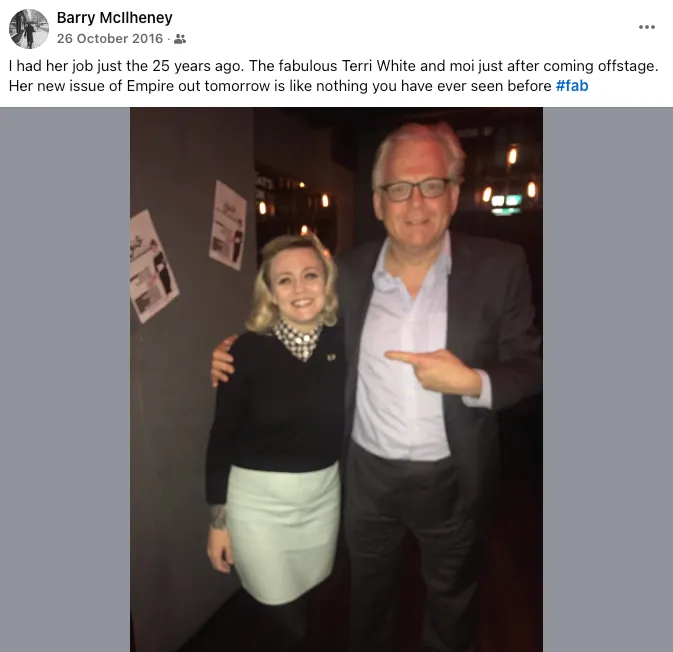
But the thread I’ve been tracing this week, is obviously, inevitably that of EMPIRE. The magazine he launched in 1989 after a suggestion from magazine genius David Hepworth (who’d co-founded music title Q with fellow-g Mark Ellen). Barry edited it for three wild, successful years. My own stewardship as EIC of EMPIRE came in 2015, my shift some six.
Just a day after landing back from New York for the gig, Baz took me out for lunch to Balthazar in Covent Garden. This is normally when ex-editors tell you the score, often try and assert the rules as they still see them. Baz, though, simply offered support, asked what I dreamt of doing with the magazine and, of course, told me a raft of spectacular stories from his days in the chair (David Lynch agreeing to come to the EMPIRE Awards if he could smoke all the way from LA; sitting next to Quentin Tarantino at the Awards [rest of the story part redacted, part forgotten]; David Schwimmer boarding the EMPIRE boat at Cannes).
And while things had certainly changed in the twenty-odd years between our tenures – A BOAT AT CANNES, ARE YOU KIDDING – some things hadn’t.
“Our mission statement at the time,” wrote Baz for the magazine’s 400th edition in 2022, “though we would never have called it that back then, was ‘At last, the movies get the magazine they deserve’. I like to think it was a promise we lived up to in those halcyon days of 1989, and a promise that holds true to this day.”
The pledges to deliver on that promise: EMPIRE would always make the film the star; lift the velvet rope and go elbow-to-elbow with insiders, closer than anyone else to the movies as they were made; would review and rate film after film, tell you what was really worth watching. It doesn’t sound radical, but it was. A blueprint, yes, arguably laid down by Q, but with EMPIRE, naturally, a different animal was born.
Barry McIlheney, Baz, Barry Mac, B Mac, Barney Tabasco – 1960-2025.
My heartfelt condolences to Lola, Frankie and Mary, who Barry spoke of often with such chest-bursting pride, and his brother Colin.
You can read an extended version of Terri’s tribute here in her substack : https://bit.ly/3T16zDi
Their session at 2.40pm will see them discuss the most up-to-date view on the AI, publishing, and copyright landscape.
Catered to publishing professionals of all backgrounds, the free-to-attend conference offers attendees excellent networking opportunities and valuable insight from world-leading publishing and rights experts.
Whether you’re seeking to deepen your understanding of copyright fundamentals or want to keep up to date with the latest licensing and policy developments, the conference has something for everyone.
To view the full conference agenda and secure your free ticket, click here.
Barry was a passionate champion of our sector, the magazine brands it represents, and the talented journalists at the heart of it. During his time as CEO of the PPA, he worked closely with members to champion the industry’s role in UK culture and business, helping keep publishing relevant and respected through times of change.
We will pay our respects to his career and various roles in the publishing sector and at the PPA in the coming days. On behalf of the PPA and our members, we extend our deepest sympathies to Barry’s family, friends, and former colleagues.