
Action 2
Resources
If you need more information, fill out the form below and we will be in touch
Quantifying and addressing value chain emissions
What is Action 2 about?
Action 2 is about reducing indirect emissions (i.e. emissions occurring throughout your value chain).
Your company’s own emissions resulting from your organisation’s direct activities are covered as part of Action 1.
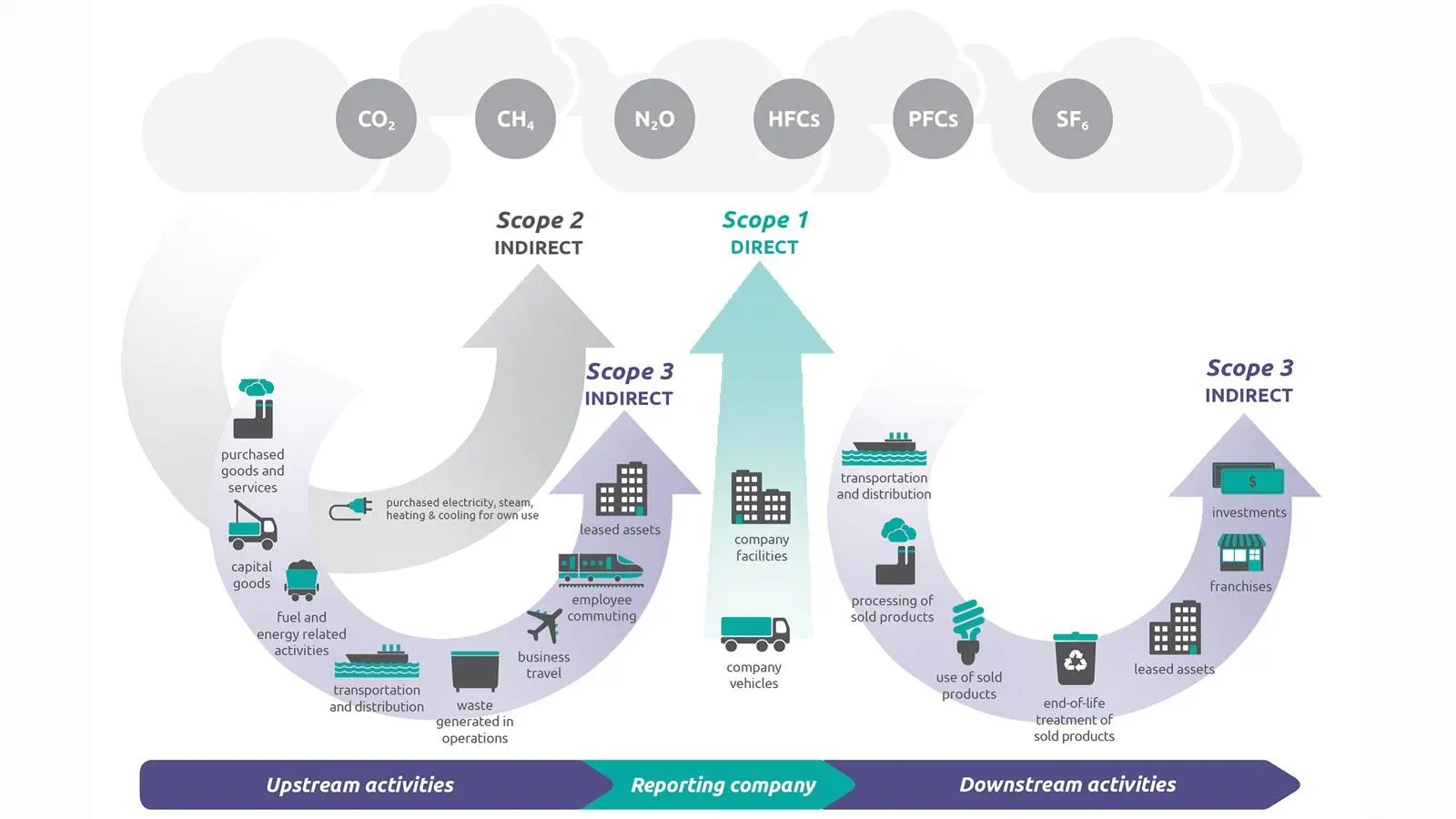
Action 2 consists of identifying the GHG emitted throughout your value chain. These are Scope 3 emissions and include emissions generated by your organisation’s upstream value chain (e.g. emitted by suppliers and distribution partners) and by your organisation’s downstream value chain (e.g. customers). Once these Scope 3 emissions are identified, they need to be measured and reported using a standardised and scientifically sound methodology.
Why is it important?
Addressing value chain emissions is essential as indirect emissions constitute the bulk of publishers’ climate impact.
For publishers, the majority of their GHG emissions are under Scope 3. It is therefore important to measure and monitor these Scope 3 emissions as it allows the organisation to understand what part(s) of the value chain emit(s) the most and identify potential ways to reduce these emissions.
Although publishers have no direct control over their Scope 3 emissions, they can make decision which can result in Scope 3 emissions reduction (e.g. by adding environmental requirements in their procurement process). They can also influence their value chain to reduce their emissions.
How to tackle it?
- The first step is to understand how to report Scope 3 emissions.
Scope 3 emissions are classified under 15 categories. Organisations need to go through these categories in order to identify which ones are related to them.
To do this, publishers may find it helpful to map their value chain. Mapping the value chain visually ensures that no activities, operations, business partners, stakeholders and Scope 3 categories have been missed.
An example of value chain for publishers as well as a high-level description of the 15 Scope 3 categories are available in the next section of the guide “Defining Scope 3 for publishers”.
To quantify your Scope 3 emissions, please use the relevant Scope 3 tool(s).
- The next step is to identify opportunities for reduction.
Scope 3 emission reductions can be achieved through trading with business partners who have implemented energy-efficient processes and/or who have switched to renewable energy. The value chain can also be reviewed to identify further reduction opportunities.
Resources
- Action 2: Defining Scope 3 for publishers
- Tools:
- Scope 3 for printed publication
- Scope 3 for events
- Scope 3 for web content
To review the relevant measurement protocols for each of the above and simplify calculations, PPA Members can download the PPA Emissions Calculator and request one-to-one support or a demo if required.
Action 2: Defining Scope 3 for publishers
There are 15 categories of emissions under Scope 3
Upstream Scope 3 emissions
- Purchased goods and services
- Capital goods
- Fuel- and energy-related activities (not included in scope 1 or scope 2)
- Upstream transportation and distribution
- Waste generated in operations
- Business travel
- Employee commuting
- Upstream leased assets
Downstream Scope 3 emissions
- Downstream transportation and distribution
- Processing of sold products
- Use of sold products
- End-of-life treatment of sold products
- Downstream leased assets
- Franchises
- Investments
Source: GHGP Corporate Value Chain (Scope 3) Accounting and Reporting Standard
High-level overview of the relevant categories for publishers:
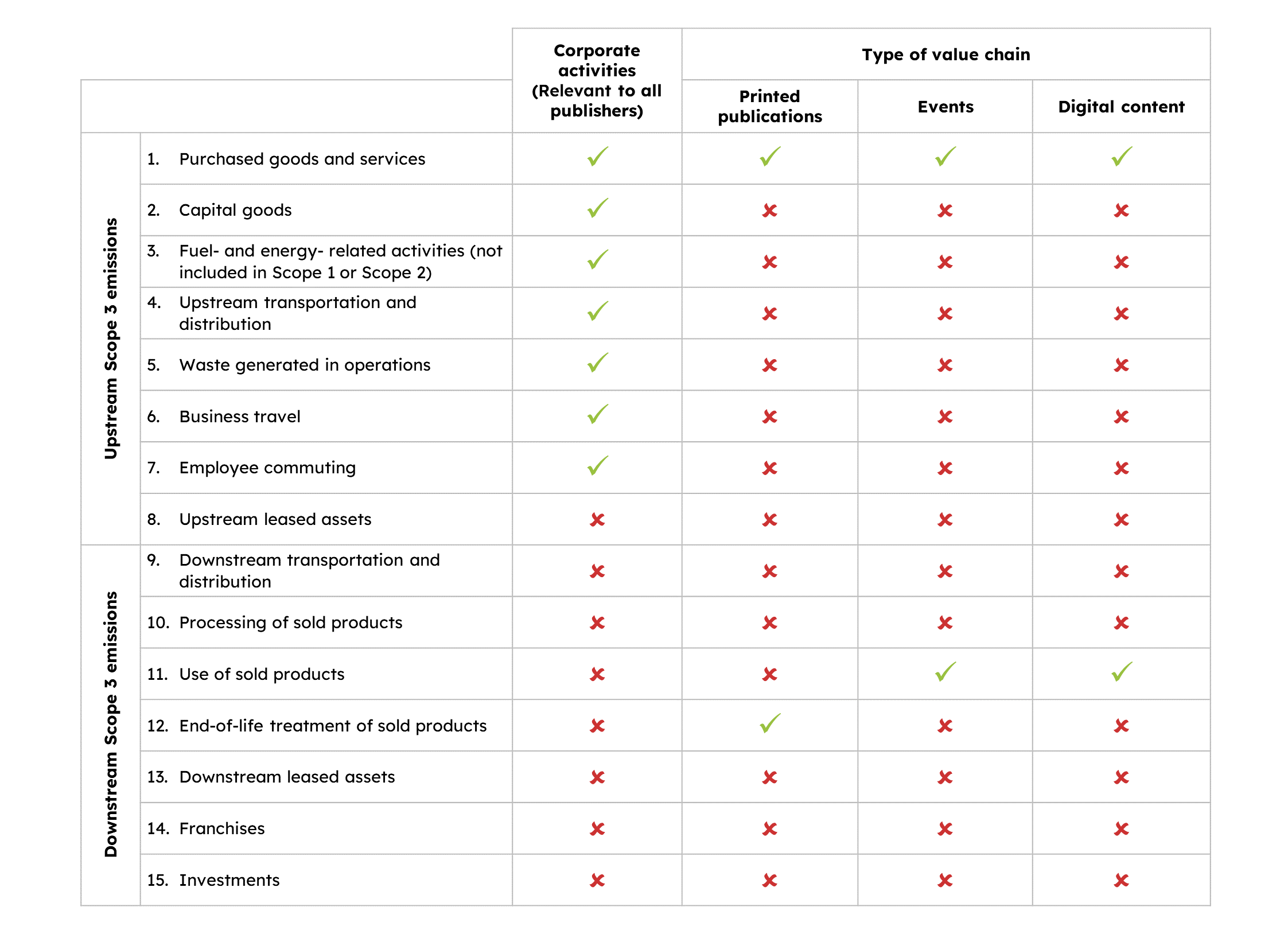
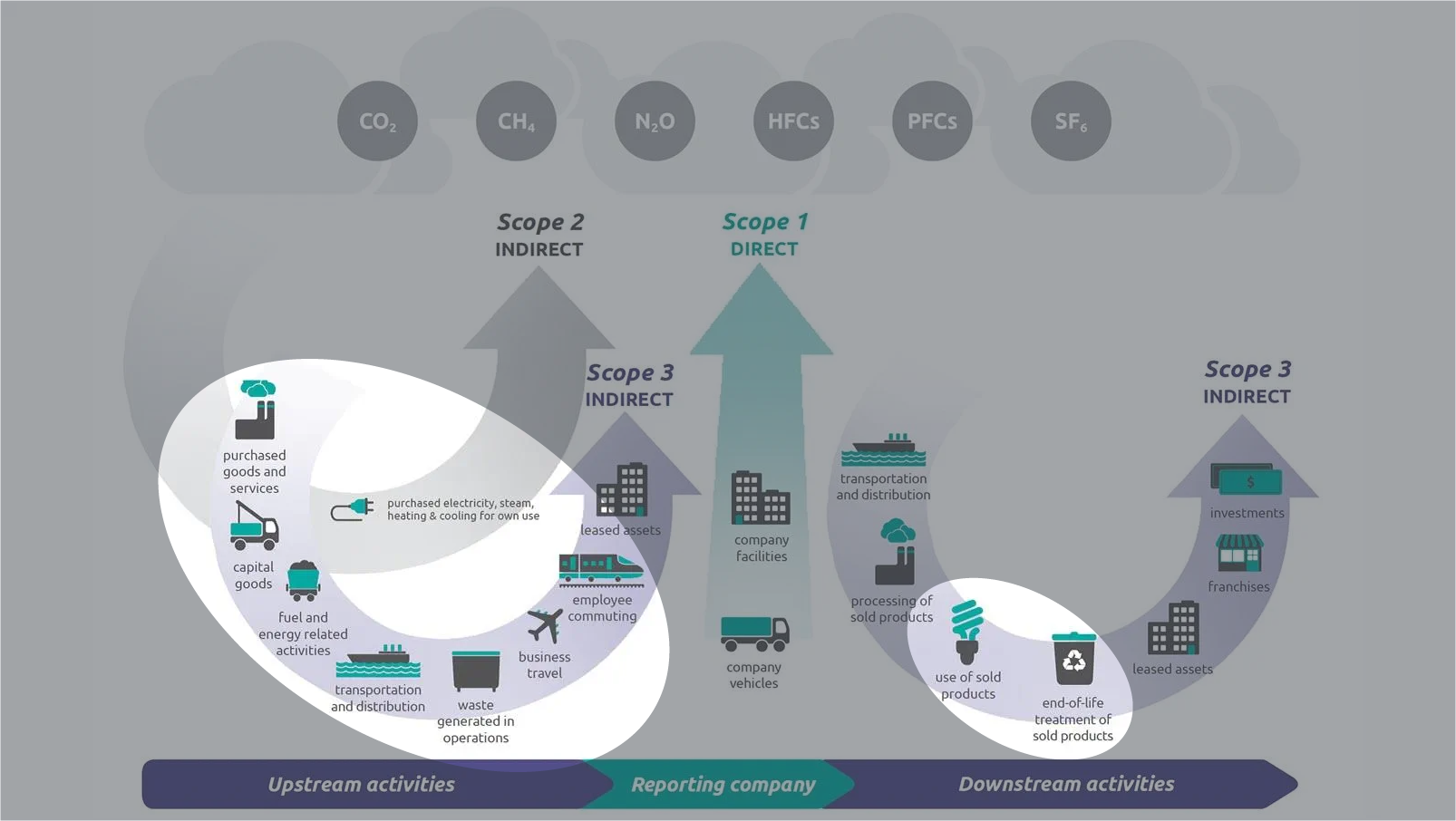
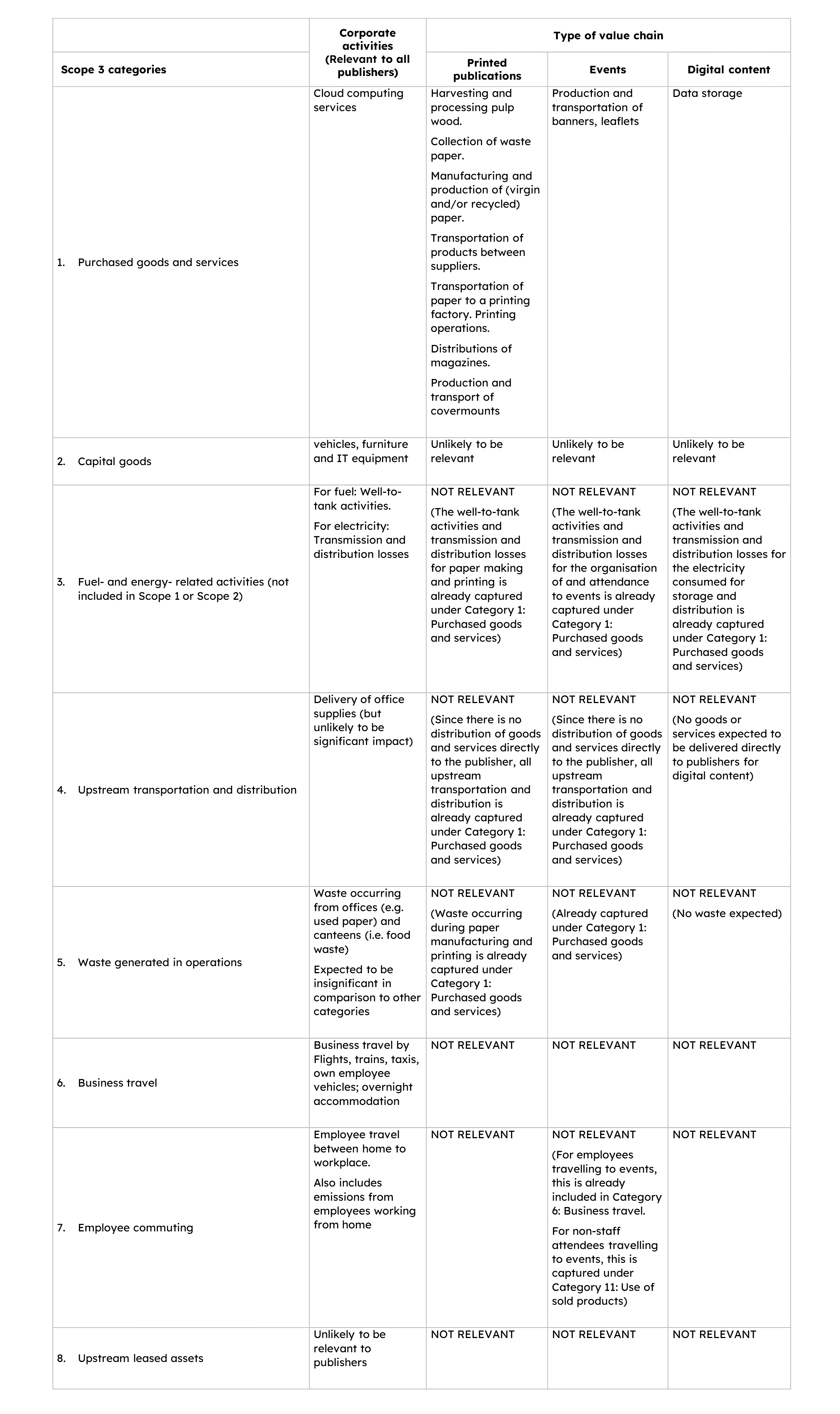
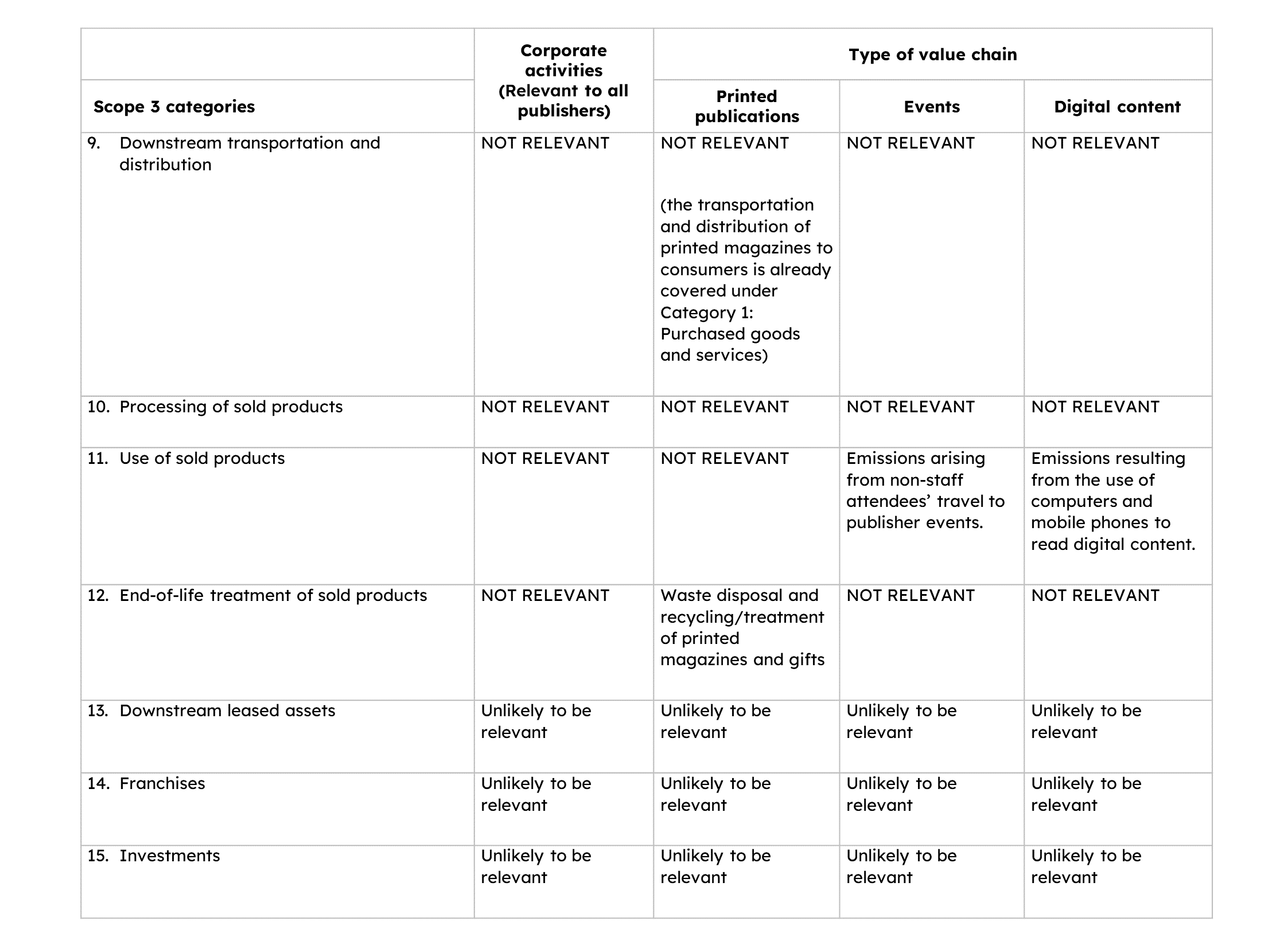
A description of the Scope 3 categories as well as examples of what the categories include are provided in the tables that follow.
In addition, further information is provided about how relevant each category is for publishers, depending on their type of value chain (i.e. whether they produce printed publications, digital content, and/or run events).
Upstream Scope 3 emissions:
Category 1: Purchased goods and services
Extraction, production, and transportation of goods and services purchased or acquired by the reporting company in the reporting year, not otherwise included in Categories 2 – 8.
This category includes all upstream (i.e., cradle-to-gate **check JT) emissions from the production of products purchased or acquired by the reporting company in the reporting year. Products include both goods (tangible products) and services (intangible products).
Includes: Manufacturing and production paper
Category 2: Capital goods
Extraction, production, and transportation of capital goods purchased or acquired by the reporting company in the reporting year.
Capital goods are final products that have an extended life and are used by the company to manufacture a product, provide a service, or sell, store, and deliver merchandise. In financial accounting, capital goods are treated as fixed assets or as plant, property, and equipment (PP&E).
Includes: Examples of capital goods include vehicles, furniture and IT equipment.
Category 3: Fuel- and energy- related activities (not included in Scope 1 or Scope 2)
Extraction, production, and transportation of fuels and energy purchased or acquired by the reporting company in the reporting year, not already accounted for in Scope 1 or Scope 2
Includes: Upstream emissions of purchased fuels and electricity from raw material extraction up to the point of, but excluding combustion
Category 4: Upstream transportation and distribution
Transportation and distribution of products purchased by the reporting company in the reporting year between a company’s tier 1 suppliers and its own operations (in vehicles and facilities not owned or controlled by the reporting company)
Transportation and distribution services purchased by the reporting company in the reporting year, including inbound logistics, outbound logistics (e.g., of sold products), and transportation and distribution between a company’s own facilities (in vehicles and facilities not owned or controlled by the reporting company)
Includes:
Not applicable to publishers as paper for publications is not delivered to the reporting organisation’s own operations
Products delivered to offices e.g. stationery products are negligeable and reporting this can be optional
Category 5:
Waste generated in operations
Disposal and treatment of waste generated in the reporting company’s operations in the reporting year (in facilities not owned or controlled by the reporting company)
Includes: Negligeable
Category 6: Business travel
Transportation of employees for business-related activities during the reporting year (in vehicles not owned or operated by the reporting company)
Includes: Transport to events, visits to suppliers
Category 7: Employee commuting
Transportation of employees between their homes and their worksites during the reporting year (in vehicles not owned or operated by the reporting company)
Includes: Traveling between home and place of work, not including business travel
Category 8: Upstream leased assets
Operation of assets leased by the reporting company (lessee) in the reporting year and not included in Scope 1 and Scope 2 – reported by lessee
Includes: Unlikely to be applicable to publishers
Relevance to publishers:
Downstream Scope 3 emissions:
Category 9: Downstream transportation and distribution
Transportation and distribution of products sold by the reporting company in the reporting year between the reporting company’s operations and the end consumer (if not paid for by the reporting company), including retail and storage (in vehicles and facilities not owned or controlled by the reporting company)
Not applicable to publishers
Category 10: Processing of sold products
Processing of intermediate products sold in the reporting year by downstream companies (e.g., manufacturers)
Not applicable to publishers
Category 11:
Use of sold products
End use of goods and services sold by the reporting company in the reporting year
Emissions resulting from the use of computers and phones to read digital content
Category 12: End-of-life treatment of sold products
Waste disposal and treatment of products sold by the reporting company (in the reporting year) at the end of their life
Waste disposal and recycling/treatment of printed magazines and gifts
Category 13: Downstream leased assets
Operation of assets owned by the reporting company (lessor) and leased to other entities in the reporting year, not included in Scope 1 and Scope 2 – reported by lessor
Not applicable to publishers
Category 14: Franchises
Operation of franchises in the reporting year, not included in Scope 1 and Scope 2 – reported by franchisor
Unlikely to be applicable
Category 15: Investments
Operation of investments (including equity and debt investments and project finance) in the reporting year, not included in Scope 1 or Scope 2
Unlikely to be applicable
Relevance to publishers:
Action 2: Managing Scope 3 emissions – Opportunities for reduction
Reduction opportunities for corporate activities:
These Scope 3 emissions categories are relevant to all publishers, regardless of their type of value chain. The table below lists, at a high-level, some reduction opportunities within each Scope 3 emissions categories.

Best contribution

Moderate contribution

Limited contribution
1. Purchased goods and services
Cloud computing services
Encourage staff to reduce amount of data saved in computers and data centres, and to delete unnecessary files and emails
If using on-premise data centre, consider switching to cloud storage. Choose an efficient data centre
2. Capital goods
Vehicles, furniture and IT equipment
Consider solutions to prevent purchasing new capital goods, for example:
- upgrade or renovate existing equipment
- rent rather than purchasing
purchase second-hand goods
Review GHG and wider environmental impact of manufacturing goods prior to purchasing. Request GHG inventory from suppliers if data is not publicly available
3. Fuel- and energy- related activities (not included in Scope 1 or Scope 2)
For fuel: Well-to-tank activities.
For electricity: Transmission and distribution losses
Reduce energy consumption through energy efficiency measures
Purchase electricity from renewable sources. For example, organisations can purchase Renewable Energy Certificates (RECs) or Power Purchase Agreement (PPA)
4. Upstream transportation and distribution
Delivery of office supplies (but unlikely to be significant impact)
Consider suppliers that deliver using electric lorries or purchase directly from local shops
5. Waste generated in operations
Waste occurring from offices (e.g. used paper) and canteens (i.e. food waste)
Expected to be insignificant in comparison to other categories.
Monitor onsite waste and set zero-waste targets. Encourage staff to reduce waste and to recycle when waste occurs
6. Business travel
Business travel by Flights, trains, taxis, own employee vehicles; overnight accommodation.
Implement (or revise) a business travel policy that includes environmental requirements (in the same way it includes costs requirements), for example:
Review the necessity to travel and attend face-to-face. Consider online meetings and virtual events
Choose the most environmentally friendly. If this is not convenient, employee must explain why (e.g. higher cost or longer travel duration)
7. Employee commuting
Employee travel between home to workplace.
Also includes emissions from employees working from home.
Review the necessity to have employees working in the office
Encourage office-based employees to walk or cycle to the office, to use public transport or use electric vehicles
Encourage employees who work from home to optimise energy usage
Note: Scope 3 emissions for corporate activities are expected to be low in comparison to other activities (e.g. Scope 3 emissions resulting from the manufacturing of paper for the publication of magazines). For this reason, most of the reduction opportunities listed in the above table only have a score of 2 or 3.
Reduction opportunities for printed publications:
1. Purchased goods and services (Upstream Scope 3 emissions)
Harvesting and processing pulp wood
Manufacturing and production of (virgin and/or recycled) paper
Ensure suppliers have shifted from fossil fuel to low-carbon and low-GHG fuels (e.g. use of self-generated biomass, combined heat and power (CHP))
Assess suppliers against environmental (and social) criteria and include in tenders the requirement to not use fossil fuel
Ensure paper is FSC (Forest Stewardship Council) or PEFC (Programme for the Endorsement of Forest Certification) certified. Regenerate forests either through direct initiatives and investments or via suppliers
Transportation of products between suppliers. Transportation of paper to a printing factory
Encourage suppliers to switch to low-carbon transportation modes
Distribution of magazines
Optimise supply chains – for example, reducing unsolds reduces GHG emissions as less paper needs to be produced, less printing needs to be commissioned, less product is distributed, and fewer unsolds need to be collected and recycled
Printing operations
Encourage suppliers to switch to renewable energy
Production and transport of covermounts
Avoid products with a short lifetime. Use recycled-content materials to manufacture the products where possible
12. End-of-life treatment of sold products (Downstream Scope 3 emissions)
Waste disposal and recycling/treatment of printed magazines and gifts
Use paper which is fully recyclable. Follow the Design for Recyclability Guidelines from CPI (Confederation of Paper Industries)
Ensure covermounts can be reused or recycled
Encourage consumers to recycle magazines at end-of-life – use the Recycle Mark
Reduction opportunities for events:
1. Purchased goods and services (Upstream Scope 3 emissions)
Production and transportation of banners, leaflets
Source from suppliers who are continuously reducing their GHG emissions, or encourage existing suppliers to use low carbon energy and technologies in their manufacturing process
Source products that reusable and recyclable at the end of their useful lives.
If products can’t be reused, ensure they are at least recyclable
Encourage suppliers to use electric vehicles for deliveries
Emissions associated with the use of venues (electricity consumption, heating, etc)
Encourage venues to measure their energy consumption and emissions. Work with venues who are taking actions to reduce their energy consumption and emissions
11. Use of sold products
Emissions arising from non-staff attendees’ travel to publisher events
Choose locations for the events that are easily accessible by trains (as opposed to locations near airports or accessible only by cars)
For events that require an international audience, consider virtual events. If face-to-face events are required, choose a location that has good train connections with other countries
Reduction opportunities for digital content:
2. Purchased goods and services (Upstream Scope 3 emissions)
Data storage
Develop digital content with size of file in mind. Develop a best practice guidance that aims at reducing the size of Digital Content through the choice of e.g. pictures and software
If using on-premise data centre, consider switching to cloud storage. Choose an efficient data centre
Develop (or review) a policy that states how long the digital content should be stored
11. Use of sold products (Downstream Scope 3 emissions)
Emissions resulting from the use of computers and mobile phones to read digital content
Develop a best practice guide aimed at customers and consumers to help them reduce the GHG emissions from the use or download of digital content.
For example;
- Advise on how best to use computers and phones to reduce their energy consumption and extend their batteries
- Remind customers and consumers who download digital content to delete the files when no longer needed